Historical photograph of Soviet Red Army troops inspecting captured German trophies including Standard 500 Kurier and DKW NZ 350 motorcycles on the Southwestern Front, winter 1941.
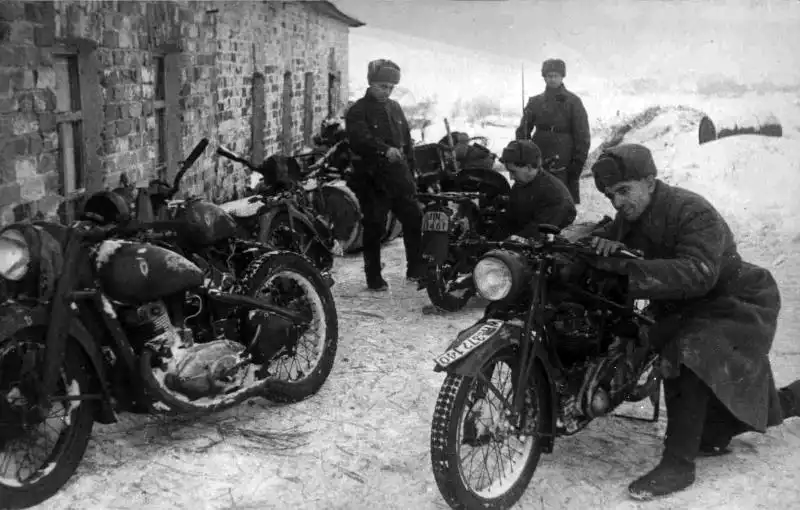
Captured German War Trophies: Red Army Troops on the Southwestern Front (Winter 1941):
This remarkable wartime photograph from the winter of 1941 captures Soviet Red Army infantrymen inspecting and servicing captured German Wehrmacht motorcycles near a brick structure on the Southwestern Front. The photograph was officially published in the Soviet newspaper Vechernyaya Moskva (No. 31/5472) on February 7, 1942.
During the heavy defensive and counter-offensive battles of 1941–1942, captured enemy motor transport provided essential mobility for Red Army recon units, messengers, and frontline commanders facing severe shortages of domestic vehicles.
Motorcycle Identification and Technical Analysis:
The photograph displays a tactical collection point featuring specific pre-war and military-issue German motorcycle models:
- Standard 500 Kurier: In the foreground on the right, a Soviet soldier kneels beside a rare Standard 500 Kurier motorcycle. Manufactured by Standard-Fahrzeugfabrik (Ludwigsburg), this heavy single-cylinder machine featured a rigid pressed-steel frame, tubular handlebars, and distinctive military registration plates mounted on the front mudguard.
- DKW NZ 350: Visible on the left is the widely used DKW NZ 350, a two-stroke single-cylinder motorcycle produced by Auto Union. Renowned for its reliability and pressed-steel frame, the NZ 350 was a workhorse of German courier (Melder) and reconnaissance units throughout the early war period.
- Registration Markings: Original Wehrmacht military registration numbers (prefixed with WH for Heeres units) remain clearly legible on the front wheel fenders of the captured machines.
Soviet Utilization of Captured German Motor Transport:
The collection, repair, and redistribution of enemy vehicles were organized under official Red Army trophy administration units (Trofeyny Otdel):
- Field Repairs and Operation: Soviet mechanics adapted captured German two-stroke and four-stroke engines to run on available lower-octane Soviet fuel and lubricants, putting serviceable machines back into immediate frontline communication duty.
- Winter Gear Details: The Red Army soldiers are wearing standard winter service dress, including heavy wool overcoats (Shinel), padded winter coats (Telogreika), and warm fur caps (Ushanka) suited for severe sub-zero operations.
📍 Location: USSR, Southwestern Front
📅 Date: Winter 1941 (Published February 7, 1942)
📷 Photographer: Unknown (Soviet War Correspondent / Vechernyaya Moskva)
📰 Primary Source: Vechernyaya Moskva Newspaper Archives (Issue No. 31)
Recommended reading:
- Technical design and deployment of the Standard 500 Kurier motorcycle
- Operational history of the DKW NZ 350 in Wehrmacht service
- Red Army trophy collection service (Trofeynyye Brigady) organization in WWII
- Soviet motor transport and motorcycle recon battalions on the Southwestern Front (1941–1942)