Exceptional historical photograph of a German Wehrmacht military dog handler operating a four-dog heavy draft cart (Hundekarren) used for frontline ammunition and medical resupply during World War II.
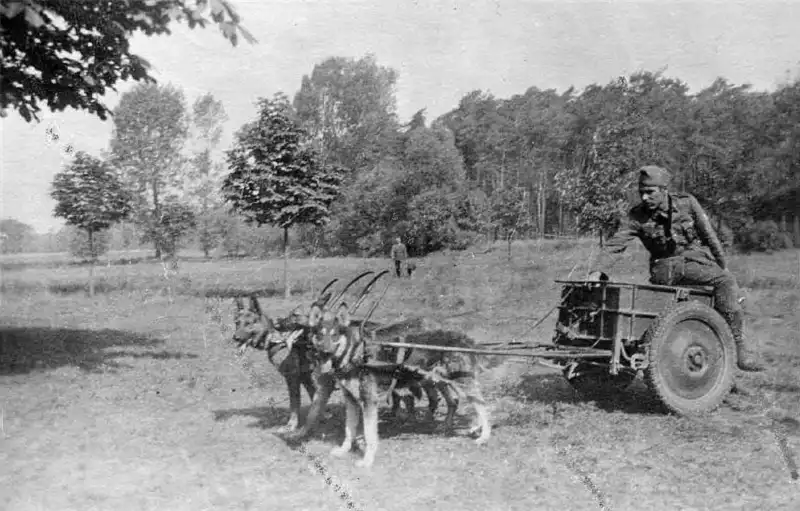
Wehrmacht Dog-Drawn Transport: Tactical Utility and K9 Logistics:
This exceptional and highly unusual historical photograph documents the deployment of military working dogs in frontline logistics by the German Wehrmacht during World War II. A K9 handler (Hundeführer) controls a specialized two-wheeled light transport cart (Hundekarren or Gefechtskarren) pulled by a team of four trained German Shepherds (Deutscher Schäferhund).
While popular historical memory often emphasizes total mechanization, the German Armed Forces relied heavily on non-motorized transport—including over 2.7 million horses and tens of thousands of specialized working dogs—to sustain frontline supply chains.
Design and Tactical Applications of the "Hundekarren":
The specialized dog-drawn cart system was developed to solve critical supply challenges in frontline sectors where motorized vehicles were immobilized or compromised by terrain:
- Frontline Resupply: Capable of transporting up to 100–150 kilograms of cargo, these light carts were primarily utilized to haul ammunition crates (for MG-34/MG-42 machine gun positions), rations, and fresh water to advanced infantry positions.
- Low Visual and Acoustic Signature: Unlike noisy trucks or motorcycles, dog-drawn teams operated with minimal noise and a low silhouette, making them ideal for night-time resupply or concealed movement along narrow trench lines and forest paths.
- Casualty Evacuation and Communications: Adapted variants served as mobile field medical posts for casualty evacuation (Sanitätswesen) and as rapid cable-laying platforms for field telephone units (Nachrichtentruppe).
Organization of the Heeres-Hundewesen (Military Dog Service):
The German Army maintained a highly structured military dog training program established prior to the outbreak of hostilities:
- Training Centers: Military K9 personnel and animals underwent rigorous training at centralized schools, such as the main Army Dog School (Heeres-Hundeschule) in Sperenberg near Berlin.
- Breed Selection: German Shepherds, Doberman Pinschers, and Rottweilers were the primary breeds selected for their physical endurance, intelligence, and adaptability to harness systems under artillery stress.
- Deployment Sectors: Dog teams were widely deployed across both the Western and Eastern Fronts, proving particularly vital in the mud conditions (Rasputitsa) of the Eastern Front and heavily forested terrain where wheeled motor vehicles failed.
📍 Location: Germany (Heeres-Hundeschule Training Facility / Rear Echelon)
📅 Date: c. 1939–1942
📷 Photographer: Unknown (Wehrmacht War Correspondent / Personal Album)
📰 Primary Source: WWII German Logistics and K9 Service Archives
Recommended reading:
- The organization and history of the Heeres-Hundewesen (Wehrmacht K9 Service)
- Non-motorized logistics and draft animal transportation in World War II
- Technical design of infantry supply carts (Gefechtskarren and Hundekarren)
- Communications and field telephone cable-laying tactics on the Eastern Front