Historic D-Day photograph of Canadian soldiers guarding captured German Wehrmacht prisoners on Juno Beach at Bernières-sur-Mer during Operation Overlord, June 6, 1944.
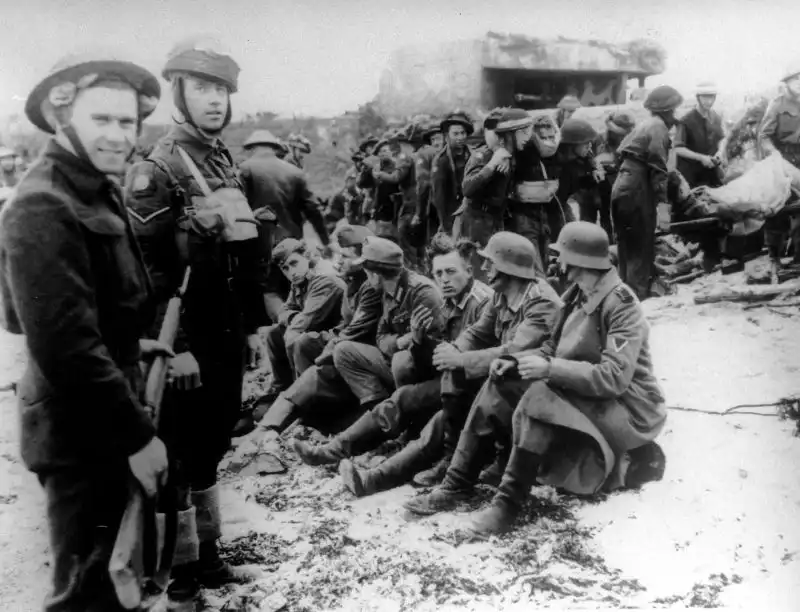
Canadian Forces on Juno Beach: D-Day Operations at Bernières-sur-Mer (June 6, 1944):
This historic photograph, taken on June 6, 1944 (D-Day), captures Canadian soldiers and military police guarding captured German Wehrmacht prisoners on the sands of Juno Beach at Bernières-sur-Mer, Normandy, during the initial phase of Operation Overlord.
Published nationwide by The Times on June 9, 1944, the image became an iconic visual record of the Canadian Army's successful assault on the Atlantic Wall fortification system.
The Assault of the 3rd Canadian Infantry Division:
The landing at Juno Beach, executed by Major-General Rodney Keller's 3rd Canadian Infantry Division alongside the 2nd Canadian Armoured Brigade, faced severe tactical obstacles during the morning assault:
- Initial Landing Hazards (08:05 AM): High tides and rough seas delayed the primary assault wave, forcing infantry to land ahead of their supporting Armoured Personnel Carriers and DD (Duplex Drive) swimming tanks.
- Heavy Resistance at La Cassine: Initial naval and aerial bombardments left key German strongpoints intact. Concentrated machine-gun and heavy artillery fire from the La Cassine coastal battery inflicted heavy casualties on initial Canadian landing craft waves.
- Naval Fire Support and Breakthrough (08:30 AM): Allied naval destroyers closed within close range of the coastline to engage fortified bunkers at point-blank range, enabling Canadian infantry and newly landed armor to suppress defensive emplacements and secure the beachhead.
German Defenders and Allied Security Personnel:
Visual analysis of the personnel on the beachhead details unit heraldry and frontline security duty:
- Wehrmacht Prisoners of War: The captured German personnel seated on the shingle belong to the 736th Infantry Regiment of the 716th Static Infantry Division, which held the coastal fortification sector between Courseulles-sur-Mer and Saint-Aubin-sur-Mer.
- Canadian Military Police (Provost Corps): Standing on the left, Canadian security and Provost Corps personnel—distinguished by shoulder flashes and military police equipment—maintain security over the captured prisoners prior to their naval evacuation to prisoner collecting stations in the United Kingdom.
- Infantry Equipment: The Canadian soldiers carry British-pattern Lee-Enfield No. 4 rifles, web gear (Pattern 1937), and specialized helmets including the Mk II "Brodie" and Mk III "Turtle" steel helmets.
📍 Location: Bernières-sur-Mer, Juno Beach, Normandy, France
📅 Date: June 6, 1944 (Published June 9, 1944)
📷 Photographer: Official Canadian Army Photograph / US National Archives
📰 Primary Source: US National Archives (NARA) / Canadian War Museum Records
Recommended reading:
- Combat history of the 3rd Canadian Infantry Division on D-Day
- Defensive tactics of the German 716th Static Infantry Division in Normandy
- The naval gunnery support operations at Juno Beach (June 6, 1944)
- Logistics of prisoner-of-war collection on Allied landing beaches