Historical photograph from June 1941 documenting a fallen Soviet Red Army soldier holding an RGD-33 grenade during the border battles in Belorussia.
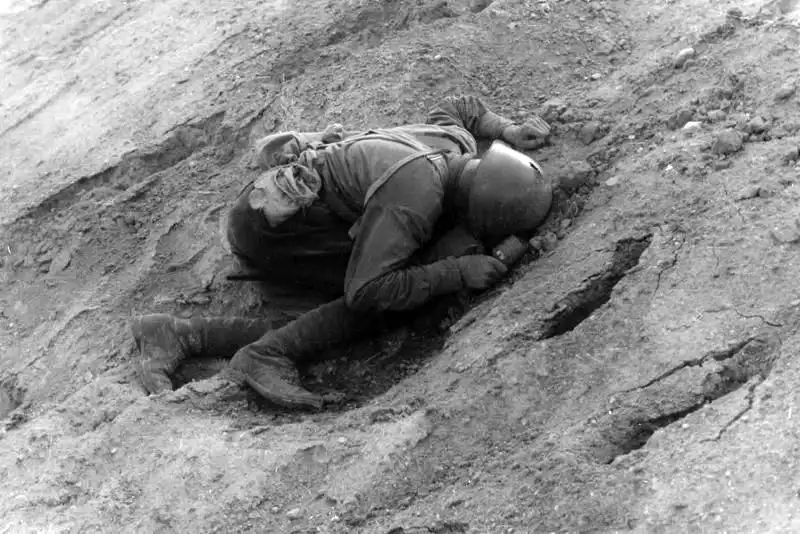
Fallen Red Army Infantryman in Belorussia (Operation Barbarossa, June 1941):
This poignant archival photograph from June 1941 captures a fallen Soviet Red Army soldier frozen in position on an embankment during the initial border battles in Belorussia. In his right hand, the soldier tightly grips an antipersonnel hand grenade, caught in the final moments before attempting a throw against advancing German armored columns.
The photograph was originally taken by a German war correspondent associated with the frontline press services (including reporters for the daily newspaper Völkischer Beobachter) attached to advance panzer divisions driving through the Western Front sector in the opening weeks of Operation Barbarossa.
Weaponry and Equipment Analysis (RGD-33 Grenade):
Visual details of the soldier's gear provide precise documentation of Red Army infantry equipment issued in early 1941:
- RGD-33 Hand Grenade with Defensive Sleeve: The soldier holds an RGD-33 stick grenade fitted with its metal fragmentation jacket (defensive sleeve / oboronitelnaya rubashka). Featuring cross-hatched scoring for controlled shrapnel dispersion, this sleeve converted the offensive grenade into a heavy defensive weapon with an effective lethal fragmentation radius of up to 25 meters.
- Helmet Damage: Visible on the top section of the soldier's steel helmet (SSh-36 or SSh-40) is a distinct shrapnel penetration hole. The original German caption inscribed on the reverse of the print noted: "Der Bolschewik hatte keine Zeit, die Handgranate zu werfen. Ein Splitter durchschlug seinen Stahlhelm" ("The Bolshevik didn't have time to throw the grenade. A shrapnel fragment pierced his steel helmet").
- Infantry Field Uniform: The soldier wears a standard 1935-pattern summer tunic (Gimnastorka) with shoulder-reinforcement patches, a leather waist belt, and rolled overcoat/equipment straps typical of frontline Red Army rifle units.
Historical Context of the 1941 Border Battles:
The image documents the intense ferocity of resistance encountered by Army Group Centre during the initial siege and encirclement battles in Belorussia (the Bialystok-Minsk pocket):
- Desperate Defense: Red Army infantrymen frequently engaged advancing German mechanized columns at close range, utilizing sticky bombs, anti-tank rifles, and hand grenades to slow enemy momentum along key transport axes.
- Archival Inscriptions: German war correspondents frequently documented close-quarters combat scenes for official propaganda archives, inadvertently creating detailed visual records of individual Soviet combat bravery.
📍 Location: Belorussian SSR, Soviet Union
📅 Date: June 1941
📷 Photographer: German War Correspondent (Völkischer Beobachter / PK Unit)
📰 Primary Source: WWII German Press Photographic Archives / Private Historical Collection
Recommended reading:
- Technical design and deployment of the Soviet RGD-33 hand grenade
- Red Army infantry gear and steel helmets (SSh-36 and SSh-40) in 1941
- Combat operations in the Bialystok-Minsk Pocket (June 1941)
- The role of German Propaganda Companies (Propagandakompanien) in Operation Barbarossa