A B-29 Superfortress with one engine out continues its mission over Osaka during one of the most destructive bombing campaigns of World War II.
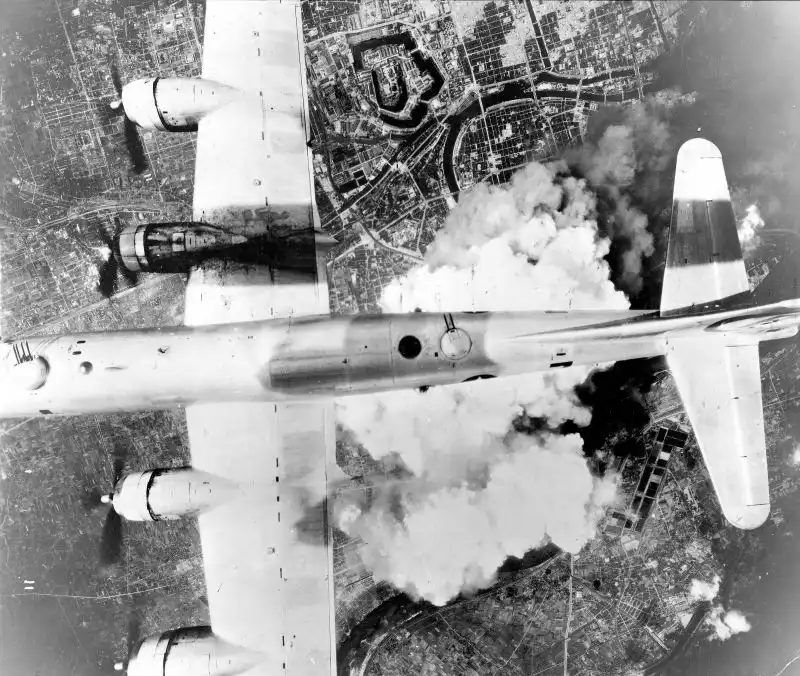
This dramatic photograph captures the American B-29A-45-BN Superfortress “Incendiary Journey” (serial number 44-61784) during a bombing mission over Osaka in March 1945.
One of the bomber's starboard engines is clearly out of action, yet the aircraft continues toward its target. Below lies one of Japan's largest industrial cities, soon to become a major victim of the American strategic bombing campaign.
The image illustrates both the enormous power of the B-29 and the destructive scale of modern industrial warfare.
The B-29 Superfortress:
The Boeing B-29 was among the most advanced combat aircraft of the Second World War.
Featuring pressurized crew compartments, remote-controlled defensive gun turrets, and long-range capability, the aircraft was specifically designed for strategic bombing missions over vast distances.
By 1945, B-29 formations operating from bases in the Mariana Islands had become the primary instrument of America's air campaign against Japan.
The aircraft shown in this photograph belonged to the 24th Bomb Squadron, 6th Bomb Group, 313th Bomb Wing of the Twentieth Air Force.
The Firebombing of Osaka:
During March 1945, American strategy increasingly shifted toward large-scale incendiary attacks against Japanese cities.
Japanese urban areas contained extensive districts built largely from wood and paper, making them especially vulnerable to fire.
On the night of March 13–14, 1945, more than 300 B-29 bombers attacked Osaka. Vast areas of the city were engulfed in flames. Additional raids followed in the days that followed, causing further destruction.
By the end of the war, approximately seventy percent of Osaka had suffered damage or destruction from aerial bombardment.
One Engine Gone, Mission Continues:
A particularly interesting detail visible in the photograph is the disabled engine.
Long-range bombing missions over Japan were hazardous even when enemy fighters were absent. Mechanical failures, engine fires, weather conditions, anti-aircraft fire, and navigational difficulties all posed serious risks.
The B-29's four-engine design provided a measure of survivability. Even after losing one engine, crews could sometimes continue the mission and return safely to base.
This image demonstrates both the durability of the aircraft and the determination of its crew.
Strategic Bombing and Total War:
The photograph also represents a controversial chapter in military history.
Strategic bombing aimed to cripple industrial production, transportation networks, and military infrastructure. However, because factories, workshops, and workers were often located within densely populated urban districts, civilians frequently suffered devastating losses.
The firebombing campaign against Japan remains the subject of historical debate regarding military necessity, effectiveness, and humanitarian consequences.
The Destruction of Japanese Cities:
Osaka was not the only target.
Throughout 1945, dozens of Japanese cities were attacked by B-29 formations. Massive quantities of high-explosive and incendiary bombs were dropped on urban and industrial centers.
Entire neighborhoods disappeared in firestorms, and millions of civilians experienced the destruction of their homes, workplaces, and communities.
The campaign demonstrated the unprecedented destructive capability of twentieth-century air power.
A Photograph of Industrialized Warfare:
What makes this image especially powerful is the contrast it presents.
In the foreground is a single aircraft battling mechanical failure while continuing its mission. Beneath it stretches an enormous city subjected to industrial-scale destruction from the air.
The photograph captures a moment when technology, logistics, and mass production combined to reshape warfare on a scale never before seen in human history.
Historical Significance:
The B-29 became one of the defining aircraft of the Pacific War and one of the most recognizable strategic bombers ever built.
Images such as this help illustrate the final months of the conflict, when air power played a decisive role in bringing the war to its conclusion.
At the same time, they remind us of the immense human cost borne by the cities that found themselves beneath the bomber streams.
Photo data:
📍 Location: Osaka, Japan
📅 Date: March 1945
📷 Photographer: Unknown
Recommended Literature:
- Richard B. Frank — Downfall: The End of the Imperial Japanese Empire
- Conrad C. Crane — Bombs, Cities and Civilians
- Kenneth P. Werrell — Blankets of Fire
- Barrett Tillman — Whirlwind: The Air War Against Japan
- Tami Davis Biddle — Rhetoric and Reality in Air Warfare
- J. Samuel Walker — Prompt and Utter Destruction