A rare KV-8S flamethrower tank from the famous “Labor Reserves to the Front” armored column. One of only ten KV-8S vehicles ever built.
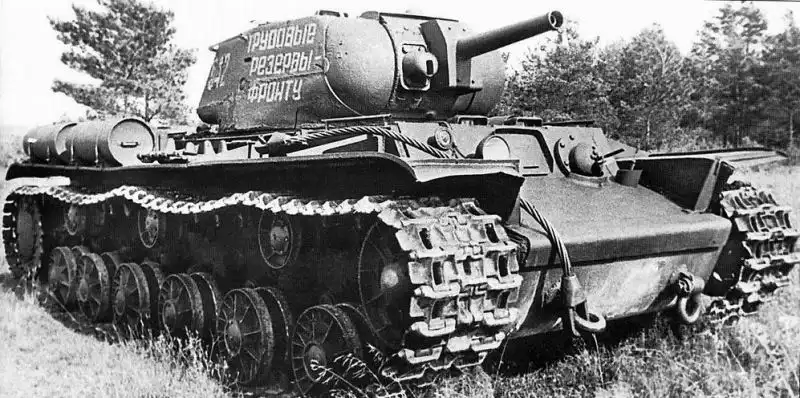
This remarkable photograph shows a Soviet KV-8S flamethrower tank belonging to the armored column “Labor Reserves to the Front”, one of the many military formations financed through public donations during the Great Patriotic War.
The patriotic slogans painted on Soviet tanks served not only as decoration but also as a powerful morale booster. Throughout the war, thousands of armored vehicles carried inscriptions reflecting the support of factory workers, collective farms, schools, and labor organizations. Such markings reminded crews that the entire country stood behind them.
In this case, the column was funded by students and trainees of vocational schools across the Soviet Union. Their donations helped finance the construction of thirty tanks, which entered combat near Stalingrad in late 1942 under the proud slogan “Labor Reserves to the Front.”
A Rare Variant of the KV Heavy Tank:
What makes this photograph particularly valuable is the vehicle itself.
The KV-8S was a flamethrower modification of the famous KV heavy tank family. Unlike conventional tanks, its primary purpose was not long-range combat but the destruction of enemy fortifications, bunkers, trenches, and strongpoints through the use of a powerful flamethrower.
The original KV-8 design incorporated the ATO-41 flamethrower in place of the machine gun normally mounted alongside the main gun. Because the flamethrower occupied valuable internal space, engineers replaced the standard 76.2 mm cannon with a smaller 45 mm gun. To conceal this reduction in firepower from enemy observers, the gun barrel was fitted with a special sleeve designed to resemble the larger 76.2 mm weapon.
This clever deception often made German troops believe they were facing a standard heavy tank until the vehicle moved into flamethrower range.
Why the KV-8 Was Feared:
Flamethrower tanks occupied a unique niche on the battlefield.
The KV-8 carried a significantly larger supply of incendiary mixture than the more common OT-34 flamethrower tank. This allowed it to deliver repeated bursts of flame against enemy defensive positions. The psychological effect of such attacks could be enormous, particularly against infantry sheltered in trenches, bunkers, or urban strongpoints.
Because of their specialized role, KV-8 and OT-34 vehicles were usually grouped into separate flamethrower tank battalions. These units were committed to some of the most difficult assault operations of the war.
The vehicle seen in this photograph is built on the lighter and faster KV-1S chassis, creating the improved KV-8S variant. Production numbers were extremely small. Historical records indicate that only ten KV-8S tanks were completed, making this one of the rarest Soviet armored fighting vehicles of World War II.
A Rare Survivor Captured by the Camera:
Photographs of flamethrower tanks are uncommon, and images clearly showing vehicles from named Soviet armored columns are even rarer.
The combination of patriotic markings and an exceptionally scarce tank variant makes this image an important visual record of both Soviet wartime industry and battlefield innovation. It reminds us that behind every armored vehicle stood not only its crew, but also countless civilians whose labor, savings, and determination helped sustain the Soviet war effort.
Photo Details:
📍 Location: USSR
📅 Date: Spring 1943
📷 Photographer: Unknown
Recommended Reading:
- KV: Technical History and Variants
- Soviet Heavy Tanks 1935–1945
- Stalin's Heavy Tanks 1941–1945
- Russian Battlefield 1943
- Red Army Armoured Units and Vehicles 1941–1945
- The KV Tank on the Battlefield