Wehrmacht soldiers inspect a damaged Soviet KV-1E heavy tank, later redesignated as Panzerkampfwagen KV-IB 755(r).
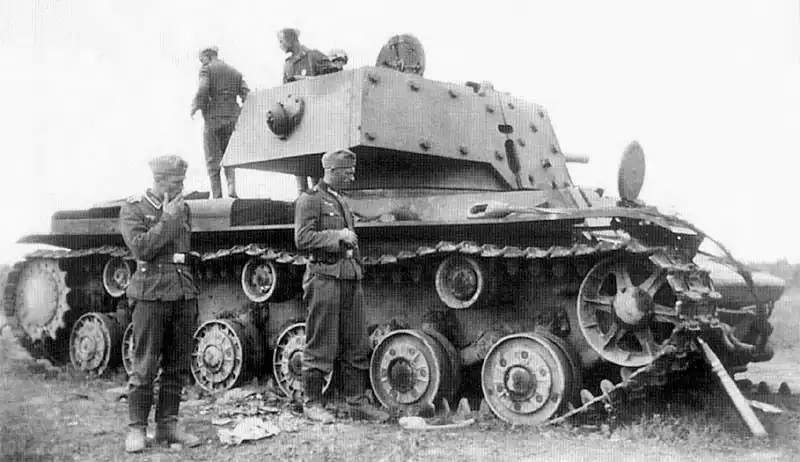
Photo Details
Location: USSR
Date: 1941
Photographer: Unknown German soldier
Captured KV-1E Heavy Tank
This wartime photograph shows German Wehrmacht soldiers inspecting a damaged Soviet KV-1E heavy tank captured during the fierce fighting of 1941. Nicknamed "Ekhranirovanny" ("Screened") by the Red Army because of its additional armor plating, the vehicle remained an impressive battlefield trophy despite its damaged condition.
A 76 mm shell lies beside the tank, the same caliber fired by the KV-1's ZiS-5 main gun. Although heavily armored, even the KV-1 became vulnerable once immobilized or attacked from exposed flanks.
German Designations for Captured KV Tanks
The Wehrmacht assigned official designations to captured KV tanks according to their production variants and configuration:
- Panzerkampfwagen KV-IA 753(r): Early KV-1 models produced in 1939–1940 with welded turrets and no appliqué armor. Some were modified with German radio equipment, commander's cupolas, and occasionally rearmed.
- Panzerkampfwagen KV-IB 755(r): The 1941 KV-1E variant with cast turret and additional armor, like the vehicle shown in this photograph. Several examples received German communications equipment for operational use.
- Panzerkampfwagen KV-IC 756(r): Later KV variants produced during 1941–1942, sometimes adapted for limited service with German units.
Captured Equipment on the Eastern Front
Although captured Soviet heavy tanks were difficult to maintain because of spare parts shortages and logistical challenges, the Wehrmacht occasionally returned serviceable vehicles to combat. Their use reflected both the practical resourcefulness of frontline units and the intense material demands of the Eastern Front.
The KV-1E seen here stands as both a battlefield relic and a reminder that armored vehicles could continue fighting under entirely different flags after changing hands.
Sources
- Captured Soviet tanks during World War II
- KV-1E heavy tank on the Eastern Front
- Wehrmacht use of captured Soviet armored vehicles