Exceptional historical photograph capturing an American GI examining a captured Polish TKS tankette modified for German Wehrmacht service in Normandy/France, 1944.
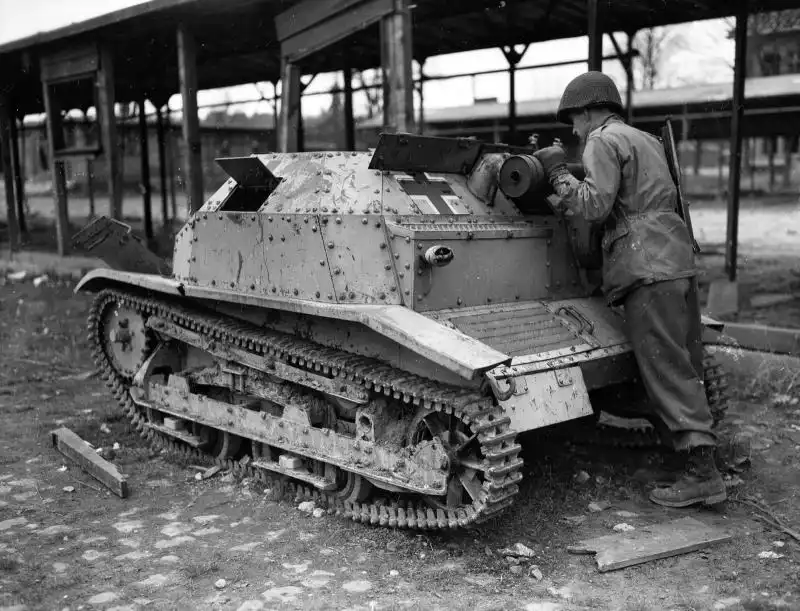
US Soldier Inspecting a Captured Polish TKS Tankette (France, 1944)
This remarkable archival photograph from 1944 depicts an American infantryman closely inspecting an unusual war trophy in Western Europe: a Polish TKS tankette (Tanksietka TKS) repurposed by the German Wehrmacht. Captured by Allied forces following the Invasion of Normandy, this vehicle represents the extensive German practice of utilizing captured enemy armor (Beutepanzer) across secondary tactical theaters.
The vehicle retains its ultra-compact two-man superstructure, fitted with Balkenkreuz national markings painted on the front armor plate and an auxiliary towing rig modified for rear-area logistics.
Origin and Technical Design of the Polish TKS
Developed in the early 1930s by the State Engineering Works (PZInż) based on the British Carden-Loyd chassis, the TKS served as the backbone of Poland's armored reconnaissance forces during the 1939 Invasion of Poland:
- Armament and Armor: The standard TKS was armed with a single 7.92 mm Hotchkiss Ckm wz.30 machine gun housed in a ball mount, protected by light 6–10 mm riveted armor plate designed to deflect small-arms fire.
- Mobility and Engine: Powered by a licensed Polski Fiat 122AC engine producing 42 hp, the lightweight 2.5-ton vehicle could reach top speeds of 40 km/h, though its off-road capability was limited by narrow track assemblies.
- Combat Performance: While obsolete against medium tanks, specialized TKS variants armed with 20 mm Nkm wz.38 FK autocannons achieved notable combat successes against early German Pz.Kpfw. I and II tanks in September 1939.
Wehrmacht Service as Beutepanzer (Leichter Raupenschlepper TKS)
Following the defeat of Poland, hundreds of functional TK and TKS tankettes were absorbed into German military logistics:
- Secondary Roles: Re-designated as Leichter Raupenschlepper TKS(p), the Luftwaffe and Wehrmacht utilized these ultra-light tracked vehicles primarily as artillery ammunition carriers, airfield bomb-tenders, and security patrol vehicles for occupation duty in France, Norway, and the Balkans.
- Allied Encounters in 1944: By the time US and British forces liberated Western Europe in 1944, Allied personnel frequently encountered rare early-war Polish, French, and Soviet combat vehicles relegated to German depot defense and auxiliary transport roles.
📍 Location: France (Western Front)
📅 Date: 1944
📷 Photographer: Unknown (US Signal Corps / Allied War Correspondent)
📰 Primary Source: World War II Allied Military Intelligence Archives
Recommended reading:
- Operational history of Polish TK-3 and TKS tankettes in September 1939
- German deployment of captured foreign armor (Beutepanzer logistics)
- The role of light auxiliary tracked vehicles on the Western Front (1944)
- Technical evolution of 1930s ultra-light reconnaissance tankettes