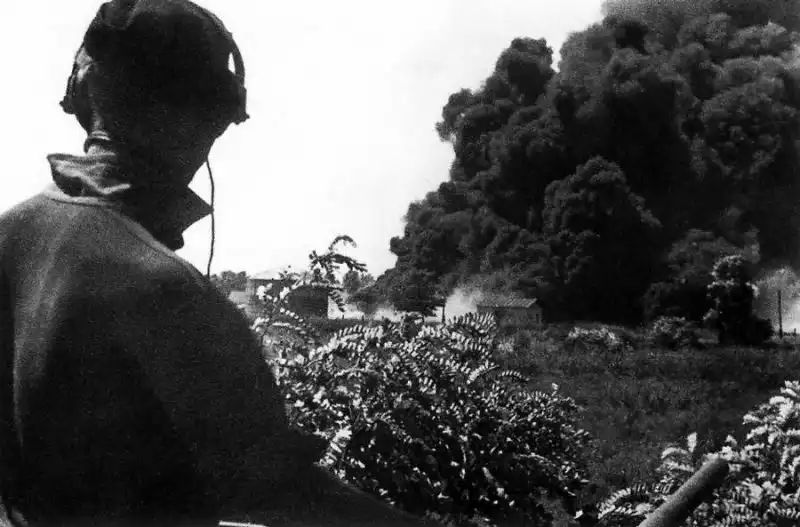
Dramatic August 1942 photograph capturing a German Pz.Kpfw. III tanker observing burning oil storage tanks set ablaze by retreating Red Army forces near Maikop during Operation Edelweiss.
German Advance on Maikop and Scorched-Earth Tactics (August 1942)
This striking historical photograph captured in August 1942 during the Battle for the Caucasus (Operation Edelweiss) depicts a German Panzer crewman standing in the command cupola of a Pz.Kpfw. III medium tank. The tanker, equipped with standard leather communication headsets, observes dense plumes of black smoke rising over burning oil storage facilities near the city of Maikop in the North Caucasus.
As Soviet Red Army formations executed a hasty tactical retreat toward Apsheronsk across the Belaya River, military engineers and industrial units systematically destroyed oil extraction wells, refineries, and fuel storage depots to deny critical petroleum reserves to advancing Axis forces.
Tactical Flanking Maneuver and Fall of Maikop
The capture of Maikop formed a central objective of the Wehrmacht's Army Group A in its drive toward the Baku and Black Sea oilfields:
- Unexpected Axis Thrust: Soviet defensive preparations originally anticipated a primary armored thrust originating from the direction of Belorechensk. However, German mobile units executed a rapid flanking maneuver driving southwest from Armavir, striking directly into the Soviet rear perimeter.
- Swift Soviet Evacuation: Faced with encirclement, Soviet units carried out a rapid withdrawal toward Apsheronsk, securing crossing points over the Belaya River while demolition teams carried out scorched-earth protocols on local fuel reserves.
- Strategic Impact on Oil Infrastructure: Although German forces captured the Maikop oilfields on August 9, 1942, thorough Soviet sabotage rendered the facilities largely non-operational, preventing Axis logistics from securing significant fuel supplies during their Caucasian campaign.
Armament and Vehicle Identification
The foreground provides clear structural details of mid-war German armored fighting vehicles:
- Pz.Kpfw. III Variant: The narrow, high-velocity gun barrel extending from the lower right frame identifies the vehicle as a variant of the Panzerkampfwagen III armed with a long-barrel 5 cm KwK 39 L/60 main gun.
- Crew Communications: The tank crewman is fitted with the standard Luftwaffe/Heer throat microphone and heavy padded headphones, critical for maintaining radio coordination within armored platoon formations.
📍 Location: Maikop, Adygea, Russian SFSR, Soviet Union
📅 Date: August 1942
📷 Photographer: Unknown (German Propaganda Company / PK Unit)
📰 Primary Source: WWII German Armored Forces Caucasus Campaign Records
Recommended reading:
- Strategic objectives and logistics of Operation Edelweiss (Caucasus Campaign 1942)
- Soviet scorched-earth demolition protocols in the Maikop and Grozny oilfields
- Technical evaluation of early Pz.Kpfw. III tank communication systems
- Tactical retreats and river crossing defenses along the Belaya River line