Archival photograph of Major General Erwin Rommel inspecting a disabled Pz.Kpfw. 38(t) light tank during the 7th Panzer Division's advance through Belgium in May 1940.
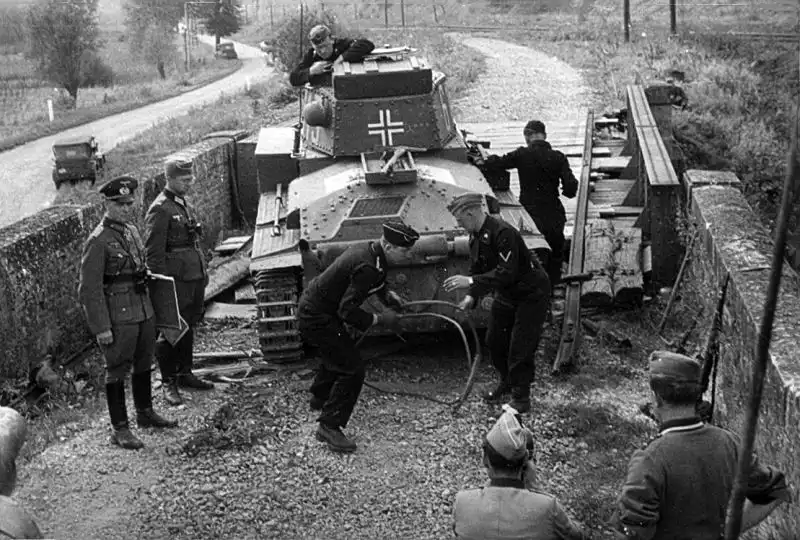
Erwin Rommel and the 7th Panzer Division in Belgium (May 1940)
This historical photograph captured during the Battle of Belgium in May 1940 shows Major General Erwin Rommel (far left, holding a map case) overseeing recovery operations for a disabled Czech-built Pz.Kpfw. 38(t) light tank. Serving as commander of the Wehrmacht's 7th Panzer Division—famously dubbed the "Ghost Division" (Gespensterdivision) due to its rapid, unpredictable advances—Rommel was renowned for directing operations directly from the frontline.
The tank lost its left track while attempting to traverse a damaged Belgian two-level road and rail overpass that had been partially demolished by retreating Allied forces. Tank crewmen in dark black protective uniforms are seen securing a steel towing cable to the rear hook of the vehicle.
The Role of Czech Armor in the 1940 Western Campaign
The Panzerkampfwagen 38(t), originally manufactured by the Czechoslovak firm ČKD as the LT vz. 38, played a crucial strategic role in the early German Blitzkrieg successes:
- Czechoslovak Ordnance Contribution: Following the occupation of Czechoslovakia in 1939, German forces incorporated large quantities of high-quality Czech armored vehicles. By May 1940, the 7th and 8th Panzer Divisions were equipped primarily with Pz.Kpfw. 38(t) tanks.
- Armament and Mobility: Armed with a 37 mm Škoda A7 gun and two MG 37(t) machine guns, the 38(t) possessed superior mechanical reliability, automotive handling, and firepower compared to the native German Pz.Kpfw. I and II light tanks.
- 7th Panzer Division Composition: Rommel's division fielded over 100 Pz.Kpfw. 38(t) units during the campaign through the Ardennes, Belgium, and northern France, relying heavily on their speed to bypass heavy Allied defensive lines.
Field Recovery and Recovery Operations
The image highlights the continuous logistical and mechanical challenges of mechanized maneuvers through urban and infrastructure chokepoints:
- Tactical Obstacles: Belgian engineers systematically demolished bridges and rail intersections to slow the armored advance, forcing German advance elements to navigate narrow detours and unstable masonry structures.
- Armored Recovery Techniques: Standard Panzer recovery doctrine required utilizing sister tanks or specialized heavy half-track prime movers (such as the Sd.Kfz. 7 or Sd.Kfz. 9) to clear narrow roadways quickly and maintain operational momentum.
📍 Location: Belgium
📅 Date: May 1940
📷 Photographer: Unknown (German Propaganda Company / PK Unit)
📰 Primary Source: World War II German Armored Forces Photographic Archive
Recommended reading:
- Combat tactics and advance routes of the 7th Panzer Division "Ghost Division"
- Technical specifications and wartime production of the Pz.Kpfw. 38(t)
- The command style of Erwin Rommel during the 1940 Campaign for France
- Belgian defensive fortifications and bridge demolitions during the May 1940 invasion