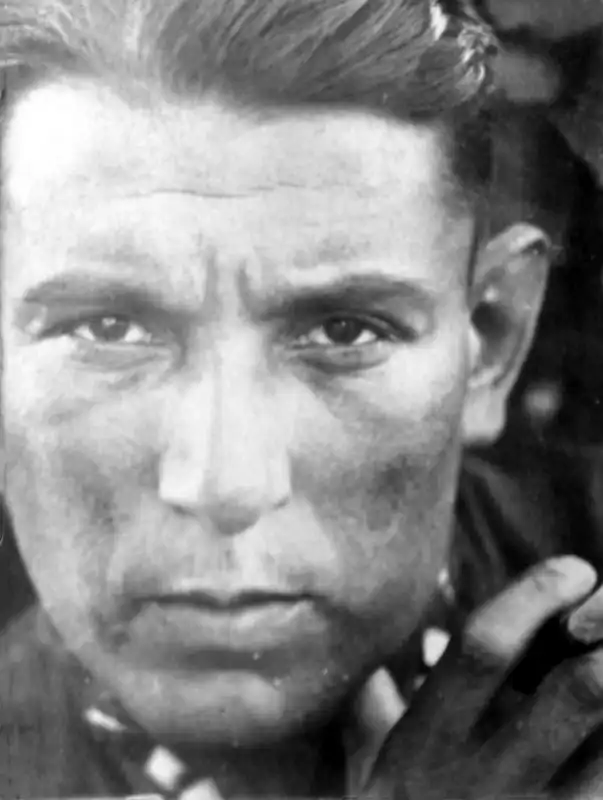
Senior Lieutenant Gilel Avseyevich Mirlin, commander of an artillery battery of the 644th Corps Artillery Regiment, photographed during the difficult months of 1941. Before the war, he was a professional geologist whose scientific career was interrupted by the German invasion.
A Geologist on the Front Line
Photographed during the difficult autumn of 1941, Senior Lieutenant Gilel Avseyevich Mirlin commanded an artillery battery of the 644th Corps Artillery Regiment, 29th Army, Western Front. Like millions of Soviet citizens, his civilian profession was abruptly replaced by military service after the German invasion of the Soviet Union.
Before the war, Mirlin had established himself as a respected geologist. A graduate of the Faculty of Geology at Kazan University, he specialized in geological mapping and later became involved in the development of advanced cartographic and geophysical methods for mineral exploration across the Soviet Union.
Leadership Under Fire
During the desperate defensive battles of 1941, Mirlin repeatedly demonstrated personal courage while directing artillery fire under combat conditions. His official commendation records one particularly dangerous action:
"Comrade Mirlin has repeatedly demonstrated personal courage and steadfastness. In August 1941, during battles along the Western Dvina River, he directed fire from a position just 400 meters from enemy trenches, enabling our infantry to seize a key height."
Such forward observation required exceptional composure. Artillery officers frequently operated close to the front line in order to adjust fire accurately, making them constant targets for enemy artillery and infantry.
From War to Science
Following the end of World War II, Mirlin returned to his scientific career. He became an influential figure in Soviet geology, working within the Ministry of Geology, Gosplan, and the Academy of Sciences of the USSR. His research focused on mineral resource planning and the strategic importance of natural resources.
Later in life, he authored the monograph Mineral Resources in the Second World War, examining how access to raw materials influenced military strategy and the global conflict.
This photograph, preserved in Mirlin's personal wartime album, documents not only a Red Army officer but also a scientist whose expertise served both his country in war and its reconstruction in peace.
Technical Photo Data
📷 Technical photo data:
🖼️ Photographer: Unknown
📅 Date: Autumn 1941
📍 Location: Soviet Union (exact location unknown)
🧍 Subject: Senior Lieutenant Gilel Avseyevich Mirlin, commander of an artillery battery, 644th Corps Artillery Regiment, 29th Army
📚 Source: Personal album of G. A. Mirlin; pamyat-naroda.ru
Recommended Literature
- David M. Glantz — When Titans Clashed: How the Red Army Stopped Hitler
- John Erickson — The Road to Stalingrad
- Chris Bellamy — Absolute War: Soviet Russia in the Second World War
- Richard Overy — Russia's War