Historical summer 1944 photograph showing three young German Flakhelfer (Luftwaffe anti-aircraft auxiliaries) of starkly contrasting heights posing in uniform during the Defense of the Reich.
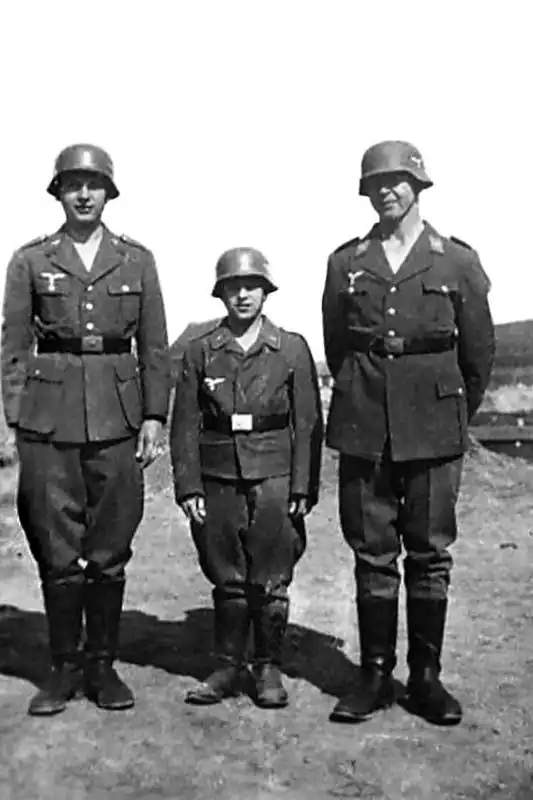
Luftwaffe Flakhelfer Auxiliaries in Germany (Summer 1944)
This evocative summer 1944 photograph captures three young German anti-aircraft auxiliaries (Flakhelfer or Luftwaffenhelfer) posing for a photo on an air defense position in Germany. The image famously highlights the striking physical contrast between the recruited teenagers, emphasizing the severe manpower shortages facing the German Wehrmacht during the late stages of World War II.
As Allied strategic bombing intensified over Germany, the German High Command increasingly mobilized secondary school students from the Hitler Youth (Hitlerjugend) to staff anti-aircraft batteries, freeing adult artillerymen for frontline service in Western Europe and on the Eastern Front.
The Role of Youth in late-war Home Air Defense
The photograph illustrates several key historical, institutional, and uniform details of the late-war auxiliary services:
- Creation of the Luftwaffenhelfer Program: Established by decree in early 1943, the program conscripted schoolboys aged 15 to 17 (from high school classes 1926–1928) into auxiliary air defense units while attempting to maintain partial schooling near their battery assignments.
- Uniform and Insignia Features: The boys are wearing standard Luftwaffe service tunics adapted for auxiliaries, featuring Luftwaffe eagle national emblems over the right breast pocket and steel helmets (Stahlhelm M40/M42) that often fit poorly on younger recruits.
- Operational Responsibilities: Flakhelfer crews operated heavy rangefinders (Kommandogerät), searchlights, sound-locating equipment, and loaded ammunition for light and heavy Flak batteries (such as the 3.7 cm Flak 36 and 8.8 cm Flak 36/37).
- Composition and Scale: By mid-1944, over 100,000 teenage boys and girls were actively serving in Luftwaffe anti-aircraft units across Germany, forming the backbone of domestic air defense against Allied bombing raids.
Impact of Late-War Total Mobilization
The reliance on adolescent auxiliaries reflected the near-total mobilization of German society under wartime stress. As the war progressed into late 1944 and early 1945, many Flakhelfer units were thrust directly into ground combat operations during the final defense of Germany's borders.
📍 Location: Germany (Reich territory)
📅 Date: Summer 1944
📷 Photographer: Unknown
📰 Primary Source: German Federal Archives (Bundesarchiv) Collection
Recommended reading:
- Air defense history: The mobilization and organization of the Luftwaffenhelfer (1943–1945)
- Home front warfare: Hitler Youth participation in the Defense of the Reich
- Anti-aircraft technology: Equipment and crew roles in German Flak batteries
- Conscription evolution: German manpower policies and total mobilization in late WWII