Dramatic summer 1941 photograph showing an early-production Soviet T-34 medium tank running over and destroying a German 3.7 cm PaK 35/36 anti-tank gun during Operation Barbarossa in the Baltic region.
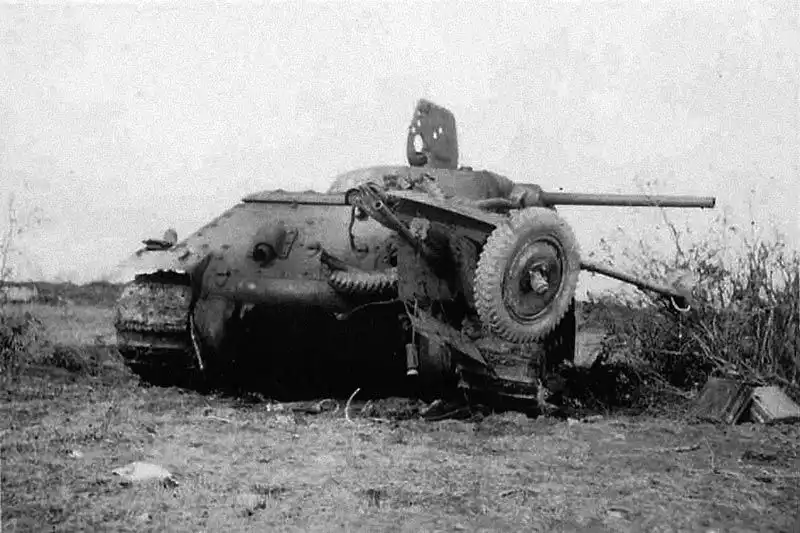
Soviet T-34 Medium Tank Crushes German PaK 35/36 Gun (Summer 1941)
This striking frontline photograph taken in the Baltic region during the summer of 1941 captures an early-model T-34 medium tank (Model 1940 equipped with a 76.2mm L-11 gun) of the Red Army's 5th Tank Division (3rd Mechanized Corps) resting directly on top of a crushed German 3.7 cm PaK 35/36 anti-tank gun.
During the opening weeks of Operation Barbarossa, Soviet tank crews frequently engaged German anti-tank positions at close range. Realizing that lightweight anti-tank guns posed minimal threat to the sloped armor of the T-34, Soviet drivers often neutralized artillery positions by crushing them under their heavy steel tracks.
Tactical Context and Equipment Breakdown
The image highlights the technological shock experienced by Wehrmacht units encountering modern Soviet medium tanks for the first time in June–July 1941:
- The "Door-Knocker" (Heeresanklopfer): The standard German 3.7 cm PaK 35/36 anti-tank gun was nicknamed the "door-knocker" by Wehrmacht crews because its small-caliber armor-piercing shells bounced harmlessly off the thick, sloped frontal armor of the Soviet T-34 and KV-1 tanks.
- Early T-34 Characteristics: The vehicle featured in the image represents the initial production run of the T-34, characterized by the single-hatch cast/welded turret, short-barreled 76.2mm L-11 tank gun, and broad tracks designed for cross-country mobility.
- Combats of the 3rd Mechanized Corps: Positioned in Lithuania and northeastern Poland, the 3rd Mechanized Corps under General Yegor Solyankin launched heavy armored counterattacks against German Army Group North around Alytus and Raseiniai in late June 1941.
- Battle Damage and Aftermath: The damaged carriage, bent trail legs, and detached rubber-tired wheel of the PaK 35/36 demonstrate the massive kinetic impact delivered by the 26-ton medium tank.
Impact on German Anti-Tank Tactics
The total ineffectiveness of the 3.7 cm PaK 35/36 against modern Soviet armor forced the German high command to urgently accelerate the deployment of heavier 5 cm PaK 38 guns, 8.8 cm Flak anti-aircraft guns in ground roles, and eventually the 7.5 cm PaK 40.
📍 Location: Baltic States, USSR
📅 Date: Summer 1941
📷 Photographer: Unknown (German War Correspondent / Red Army Tactical Archive)
📰 Primary Source: Central Archive of the Russian Ministry of Defence (CAMD) / RGAKFD
Recommended reading:
- Early armor encounters: The Battle of Alytus and the 5th Tank Division in 1941
- Artillery development: Technical limitations of the 3.7 cm PaK 35/36 anti-tank gun
- Tank design evolution: The L-11 versus F-34 main gun upgrades on the T-34
- Operational history: Armored warfare during Operation Barbarossa in the Baltic region