A remarkable 1944 photograph showing young wartime veterans of the Soviet Union on Palace Square in Leningrad after being accepted into the newly created Suvorov Military School.
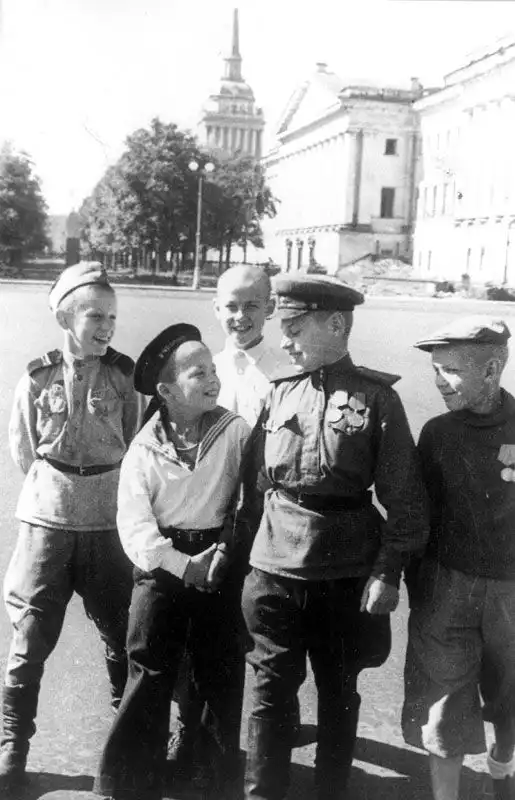
One of the most famous photographs from wartime Leningrad captures a group of boys standing proudly on Palace Square in 1944. Although still children, many of them had already experienced the hardships of war, served alongside Red Army units, survived the Siege of Leningrad, and earned military decorations.
The image symbolizes both the tragedy and resilience of a generation whose childhood was interrupted by the largest conflict in human history.
Boys Who Became Soldiers:
The photograph shows future cadets accepted into the newly established Suvorov Military School system. These schools were created in 1943 to educate and support children who had lost parents during the war or had already become connected with military units.
From left to right are:
- Guards Junior Sergeant Nikolai Koliverdov (born 1930), a ward of the 14th Guards Rifle Brigade and the 20th Front Reserve Motor Transport Regiment of the Leningrad Front;
- Guards Junior Sergeant Yevgeny Bilindinov, awarded the Medals "For the Defense of Stalingrad" and "For the Defense of Leningrad";
- Yuri Ivanov;
- Corporal Afanasy Shkuratov (born 1930), a ward of the 935th Artillery Regiment of the 381st Rifle Division and the 919th Artillery Regiment of the 358th Rifle Division. He was awarded two Medals "For Courage" and later participated in the Victory Parade of 1945;
- Yuri Stepenko, recipient of the Medal "Partisan of the Patriotic War" and the Medal "For the Defense of Leningrad".
Even a brief look at this list reveals an extraordinary fact: several of these boys had already earned combat awards before reaching adulthood.
The Children of the Great Patriotic War:
During the war thousands of Soviet children became connected with military formations. Some worked as messengers, scouts, and orderlies. Others were adopted by front-line units after losing their families during the fighting.
These "sons of regiments" and military wards often shared the same dangers as the soldiers around them. While their duties varied greatly, many witnessed combat, air raids, artillery bombardments, and the hardships of life near the front.
The boys in this photograph represent that generation. Their uniforms, medals, and confident expressions stand in sharp contrast to their young age.
Leningrad in 1944:
The photograph was taken in 1944, only months after the lifting of the Siege of Leningrad. The city had endured nearly 900 days of blockade, starvation, bombardment, and immense civilian suffering.
Against this backdrop, the creation of Suvorov schools carried special significance. They were intended not only to educate future officers but also to provide stability and opportunity for children whose lives had been shaped by war.
Standing on the historic Palace Square, these young cadets became symbols of survival and renewal after one of the darkest chapters in Soviet history.
A Powerful Symbol of Victory and Survival:
What makes this photograph so memorable is not the military uniforms or decorations, but the faces themselves. They are children, yet their biographies already contain experiences that many adults never face in a lifetime.
The image reminds us that the Second World War was fought not only by generals and armies but also by an entire generation whose youth was consumed by conflict. For many Soviet children, victory in 1945 was not merely a military triumph—it was the chance to finally return to a normal life.
Sources of information about the photograph:
- Newspaper Leningradskaya Pravda, No. 210 (8934), September 2, 1944.
- www.leningradpobeda.ru
📍 Location: Leningrad, USSR
📅 Date: 1944
📷 Photographer: David Trakhtenberg
Recommended Reading:
- Alexander Werth — Russia at War 1941–1945
- Harrison E. Salisbury — The 900 Days: The Siege of Leningrad
- Anna Reid — Leningrad: Tragedy of a City Under Siege, 1941–1944
- Dmitri Likhachov — Reflections on the Siege of Leningrad
- David Glantz — The Siege of Leningrad 1941–1944
- Richard Bidlack & Nikita Lomagin — The Leningrad Blockade, 1941–1944: A New Documentary History