Soviet ski scouts in white camouflage disembark from NKL-16 aerosleds during a winter reconnaissance mission behind enemy lines in 1942–1943.
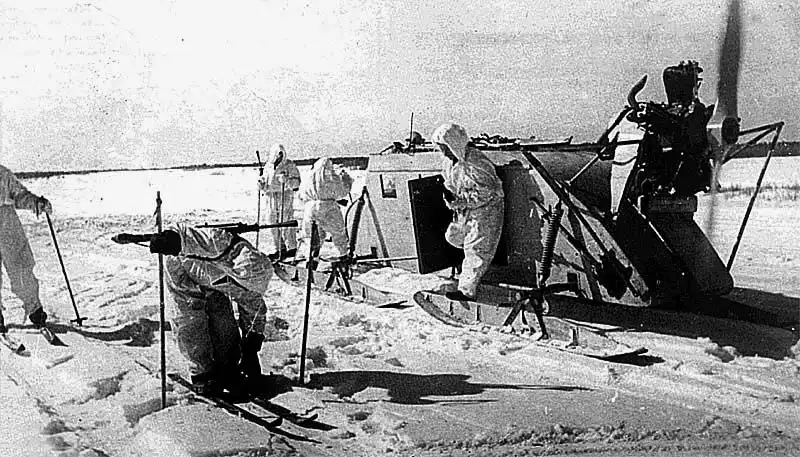
This striking winter photograph captures a group of Soviet ski scouts disembarking from NKL-16 aerosleds during a reconnaissance mission on the Eastern Front in the winter of 1942–1943. Dressed in white winter camouflage and armed with automatic weapons, the soldiers are preparing to move across snow-covered terrain where conventional vehicles could rarely operate.
The image illustrates one of the lesser-known but highly effective methods used by the Red Army to maintain mobility during the harsh Russian winter.
Winter Warfare on the Eastern Front:
Snow and extreme cold were constant features of military operations in the Soviet Union. During winter campaigns, roads often became impassable and deep snow slowed the movement of troops, artillery, and supplies.
To overcome these difficulties, Soviet forces relied on specially trained ski units capable of traveling rapidly across terrain that would stop ordinary infantry. These formations conducted reconnaissance, raids, courier missions, and surprise attacks against enemy rear areas.
Operating on skis allowed soldiers to move quietly through forests, frozen fields, and marshlands while remaining difficult to detect.
The NKL-16 Aerosled:
The vehicle seen in the photograph is an NKL-16 aerosled, a lightweight wooden transport powered by an aircraft engine driving a rear-mounted propeller.
Unlike tracked or wheeled vehicles, aerosleds moved over snow using large skis. Their design made them particularly useful in northern regions and during winter operations where ordinary transport struggled to function.
The NKL-16 was primarily intended for transporting personnel, supplies, communications teams, and reconnaissance groups. In winter conditions it could move much faster than marching infantry and often served as a valuable link between isolated units.
Although less famous than tanks or aircraft, aerosleds became an important component of Soviet winter mobility.
Reconnaissance Behind Enemy Lines:
The soldiers in the photograph appear to be front-line reconnaissance troops. Their white camouflage suits blend into the snowy landscape, making them difficult to spot at a distance.
Reconnaissance units played a critical role in Soviet operations. They gathered intelligence on enemy troop movements, identified defensive positions, captured prisoners for interrogation, and reported on road and supply conditions.
Such missions were dangerous. Scouts often operated far ahead of friendly forces and risked encirclement if discovered. Speed, stealth, and local knowledge were often their best protection.
The combination of skis and aerosled transport allowed Soviet reconnaissance teams to cover large distances quickly while retaining the ability to move silently once they reached their objective.
A Rare Glimpse of Specialized Winter Forces:
Photographs of Soviet ski troops are not uncommon, but images showing their deployment from aerosleds are far less frequently encountered. As a result, this photograph offers a valuable look at a specialized aspect of Red Army winter warfare.
It also demonstrates how Soviet forces adapted to the severe environmental conditions of the Eastern Front. Rather than viewing snow and cold solely as obstacles, military planners sought ways to turn winter into an operational advantage.
The NKL-16 and the ski scouts who rode in it became part of that effort, helping Soviet forces maintain mobility and initiative during some of the most challenging campaigns of the war.
📍 Location: USSR
📅 Date: Winter 1942–1943
📷 Photographer: Unknown
Recommended Reading:
- David M. Glantz — Soviet Military Operational Art
- David Stahel — The Eastern Front 1941–1945
- Chris Bellamy — Absolute War: Soviet Russia in the Second World War
- Steven J. Zaloga — Red Army Handbook 1939–1945
- Boris Kavalerchik — The Tanks of Operation Barbarossa
- Robert Forczyk — Moscow 1941: Hitler's First Defeat