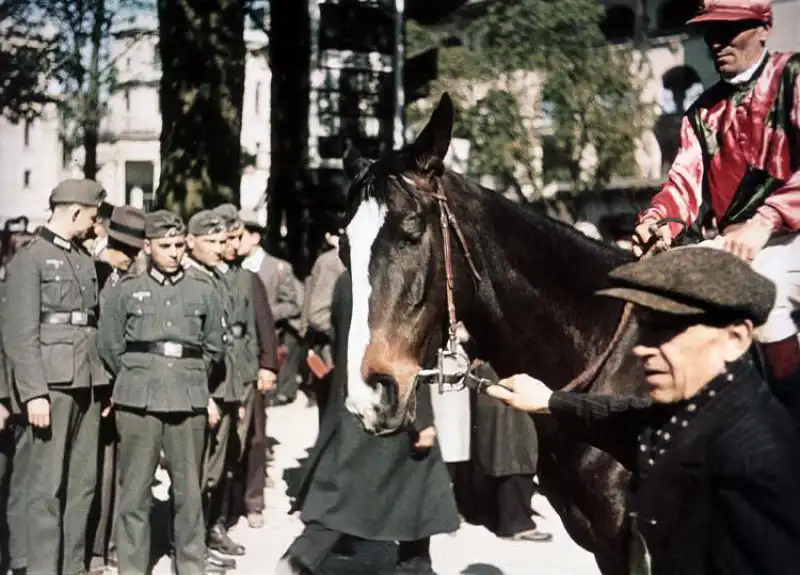
Color WWII photograph showing jockeys being weighed before horse races at Longchamp Racecourse in occupied Paris while German soldiers observe the event in 1943.
Horse Racing Under Occupation:
This unusual color photograph captures the traditional weighing of jockeys before a horse race at Longchamp Racecourse in occupied Paris during August 1943.
What makes the image especially striking is the presence of German soldiers calmly observing the event alongside French civilians.
The photograph perfectly illustrates the strange coexistence of:
- Occupation
- Entertainment
- Military presence
- Everyday civilian life
inside wartime Paris.
The Location – Longchamp Racecourse:
The scene takes place at the famous Longchamp Racecourse, one of the most prestigious horse racing venues in France.
Longchamp was associated with:
- Elite Parisian society
- Fashion culture
- Gambling
- Luxury entertainment
Even during World War II, racing events continued under German occupation.
Why Jockeys Were Weighed:
Horse racing required strict control over jockey weight.
Before each race, officials checked:
- Rider weight
- Equipment weight
- Compliance with racing regulations
Even small weight differences could affect the outcome of a race.
The scene shown in the photograph was therefore a completely standard part of horse racing tradition.
German Soldiers in Paris:
By 1943, German military personnel had become a common sight in Paris.
Soldiers visited:
- Cafés
- Restaurants
- Parks
- Sporting events
The occupation authorities attempted to maintain an image of order and normalcy inside the French capital.
A City Living Beside the War:
One of the most fascinating aspects of occupied Paris is how ordinary activities continued despite the global conflict.
While battles raged on the Eastern Front and Allied bombers attacked Europe:
- Horse races still took place
- Crowds gathered for entertainment
- Civilian routines survived
This strange contrast appears constantly in the photographs of André Zucca.
The Atmosphere of Occupied Paris:
Photographs like this can create the impression that occupation was relatively comfortable.
But beneath the surface existed:
- Food shortages
- Political fear
- Arrests
- Deportations
- Resistance activity
The calm atmosphere shown in public spaces often hid much harsher realities.
Entertainment During Wartime:
Governments and occupation authorities frequently encouraged entertainment during wartime because it helped:
- Maintain morale
- Reduce public tension
- Create an illusion of stability
Sporting events became part of this psychological environment.
The Photographer – André Zucca:
This photograph was taken by André Zucca, whose color images of occupied Paris became some of the most famous civilian photographs of World War II.
His work focused heavily on:
- Streets
- Fashion
- Markets
- Social life
rather than direct combat or destruction.
Rare Color Photography – Agfacolor:
The vivid tones of the image were possible thanks to Agfacolor film.
Because color photography remained technically difficult and expensive during the early 1940s, surviving color images from occupied Europe are historically valuable.
Longchamp During the War:
The continuation of horse racing at Longchamp symbolized the persistence of elite Parisian culture during occupation.
Despite wartime conditions:
- High society still gathered
- Sporting traditions survived
- Fashion remained important
Paris attempted to preserve its identity even while controlled by Nazi Germany.
The Strange Normality of Occupation:
This image demonstrates one of the most unsettling truths about wartime occupation:
Daily life rarely stops completely.
People continue to:
- Work
- Socialize
- Attend events
- Seek entertainment
even while war reshapes the world around them.
Historical Photograph Information:
Location: Paris, France
Date: August 1943
Photographer: André Zucca
Recommended Books on Occupied Paris:
1. France Under the Germans — Julian Jackson
2. When Paris Went Dark — Ronald Rosbottom
3. Paris After the Liberation — Antony Beevor & Artemis Cooper
4. The Invention of Paris — Eric Hazan