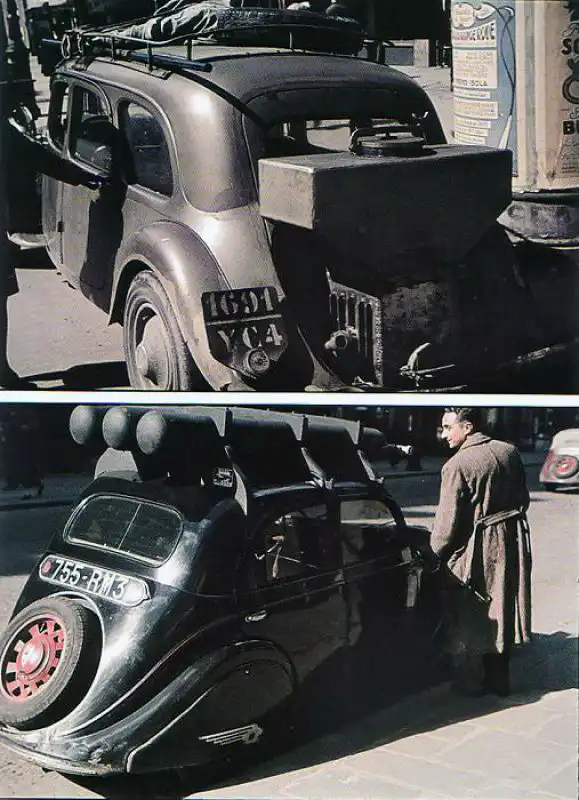
Rare color WWII photographs showing French civilian cars modified to run on coal gas during the German occupation of Paris in 1943.
Paris Without Gasoline:
These remarkable color photographs show French civilian automobiles operating on alternative fuel systems in occupied Paris during 1943.
During the German occupation, gasoline became almost impossible for ordinary civilians to obtain because fuel supplies were prioritized for:
- The Wehrmacht
- German logistics
- Occupation authorities
As a result, civilians were forced to improvise.
Cars Powered by Coal and Gas:
The vehicles in these photographs used systems based on:
- Coal gas
- Wood gas
- Gas generators
These unusual wartime technologies allowed automobiles to continue operating despite catastrophic fuel shortages.
Large external generator units converted solid fuel into combustible gas that could power an internal combustion engine.
Wartime Improvisation in Occupied France:
By 1943, fuel scarcity had transformed civilian transportation across occupied Europe.
People adapted through:
- Bicycle transport
- Horse-drawn wagons
- Gas-powered conversion systems
- Alternative fuels
The elegant boulevards of Paris suddenly featured vehicles that looked almost experimental.
The Car on the Upper Photograph – Citroën Traction Avant:
The upper image features a Citroën Traction Avant, one of the most legendary French automobiles ever built.
The Traction Avant became famous for its advanced engineering:
- Front-wheel drive
- Monocoque body construction
- Excellent handling
- Low silhouette
Produced between 1934 and 1957, it was considered highly modern for its era.
Peugeot 202 in Wartime Paris:
The lower photograph shows two Peugeot 202 vehicles:
- A gas-powered sedan
- A convertible model
The Peugeot 202 became one of the recognizable civilian cars of wartime France.
Red Wheels and the French Resistance:
One fascinating detail mentioned in historical accounts is the use of red-painted wheels.
According to wartime anecdotes:
Members of the French Resistance sometimes used red-colored wheels as a subtle recognition symbol.
Although difficult to verify universally, such details reflect the atmosphere of secrecy and hidden communication during the occupation.
Occupied Paris Was Technologically Creative:
Necessity forced innovation.
Without access to normal fuel supplies, mechanics across Europe developed:
- Improvised gasifier systems
- Emergency fuel conversions
- Alternative transport technologies
These systems were inefficient but allowed essential movement during wartime shortages.
The Photographer – André Zucca:
These photographs were taken by André Zucca, whose color images became some of the most recognizable visual records of occupied Paris.
His work documented:
- Streets
- Transportation
- Fashion
- Civilian daily life
during the German occupation.
Rare Color Photography – Agfacolor:
The images were likely created using Agfacolor film, one of the most important color processes of the era.
Because color photography remained rare during World War II, such images provide unusually vivid insight into wartime urban life.
Fuel Crisis in Occupied Europe:
Fuel shortages affected almost every occupied country.
Civilian populations experienced:
- Restricted travel
- Reduced commerce
- Limited transport services
Meanwhile, military vehicles continued receiving priority access to gasoline.
A Different Face of World War II:
Most WWII photographs focus on:
- Combat
- Tanks
- Bombings
- Destruction
But these images reveal another side of the war:
Adaptation.
They show how civilians altered everyday life simply to keep moving.
The Strange Appearance of Wartime Cars:
Vehicles equipped with gasifier systems often appeared bizarre compared to normal automobiles.
Extra components included:
- External tanks
- Pipes
- Generator chambers
- Fuel containers
Yet during the war, these strange machines became common across Europe.
Historical Photograph Information:
Location: Paris, France
Date: 1943
Photographer: André Zucca
Recommended Books on Occupied France and Wartime Civilian Life:
1. France Under the Germans — Julian Jackson
2. When Paris Went Dark — Ronald Rosbottom
3. The Invention of Paris — Eric Hazan
4. Paris After the Liberation — Antony Beevor & Artemis Cooper