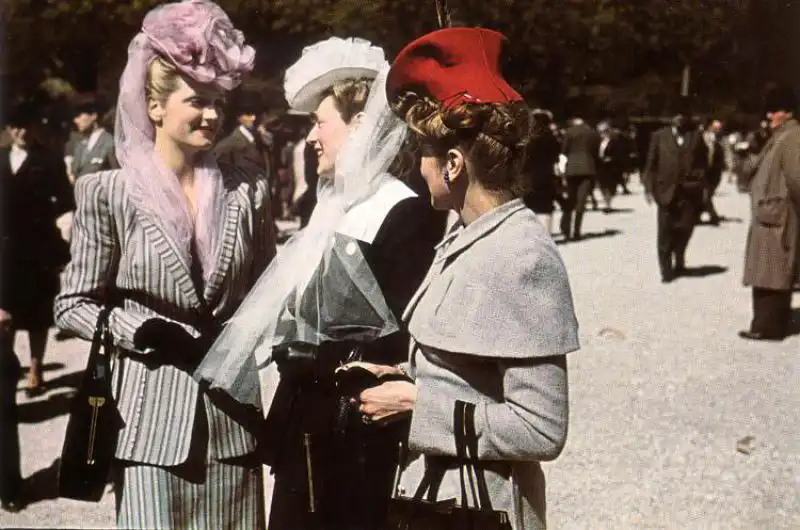
Color WWII photograph of famous Parisian fashion designers at Longchamp Racecourse during the German occupation of Paris in 1943.
Fashion and High Society During Wartime:
This remarkable color photograph captures famous Parisian fashion designers Rosa Valois, Madame Le Monnier, and Madame Agnès attending horse races at Longchamp Racecourse in occupied Paris during August 1943.
The image feels almost surreal:
- Elegant clothing
- Wealthy spectators
- A glamorous social event
Yet Europe was fully engulfed in World War II.
The Setting – Longchamp Racecourse:
The women were photographed at the famous Longchamp Racecourse, one of the most prestigious horse racing venues in France.
Before the war, Longchamp symbolized:
- Luxury
- Parisian elite culture
- Fashion society
- Upper-class entertainment
Even under occupation, elite social life did not completely disappear.
Paris in 1943 – A City of Contradictions:
By 1943:
- Germany occupied most of France
- The war was turning against the Axis
- Allied bombing campaigns intensified
- Resistance activity expanded
Yet in Paris:
- Horse races continued
- Cafés remained open
- Fashion culture survived
This contrast makes photographs like this historically fascinating.
The Women in the Photograph:
The image features prominent figures from the Paris fashion world:
- Rosa Valois
- Madame Le Monnier
- Madame Agnès
These women represented the elite circles of wartime Parisian society.
Paris Fashion Under Occupation:
Despite shortages and rationing, Paris remained one of the world’s fashion capitals.
Designers adapted through:
- Simpler materials
- Creative tailoring
- Reused fabrics
- Elegant minimalism
Fashion during the occupation became:
👉 A statement of identity
👉 A symbol of continuity
👉 Sometimes even quiet defiance
Luxury in a Time of War:
The photograph also reveals the unequal reality of occupation.
While some Parisians attended social events, others experienced:
- Food shortages
- Poverty
- Fear of arrest
- Deportation
Occupied France was deeply divided by class and circumstance.
The Photographer – André Zucca:
This image was taken by André Zucca, famous for his color photography of occupied Paris.
His work remains controversial because it often focuses on:
- Stylish civilians
- Urban elegance
- Everyday life
rather than direct wartime suffering.
Color Photography in Occupied Paris – Agfacolor:
The vivid colors of the photograph were made possible through Agfacolor film technology.
Color images from World War II remain rare and valuable because they present history in a way that feels immediate and real.
The Social Atmosphere of Occupied Paris:
Many upper-class Parisians attempted to preserve prewar social rituals:
- Horse racing
- Fashion events
- Fine dining
- Public promenades
This created the impression that normal life continued despite occupation.
Collaboration, Survival, and Adaptation:
French society during the occupation cannot be reduced to simple categories.
Some people:
- Collaborated openly
- Adapted pragmatically
- Avoided politics entirely
Others secretly supported resistance networks.
Most civilians simply tried to survive.
The Strange Duality of Occupied Paris:
Photographs like this reveal one of the strangest aspects of wartime France:
👉 Glamour existed beside repression
While elegant spectators watched horse races:
- Resistance fighters were hunted
- Jews faced deportation
- Allied and German armies fought across Europe
This duality defines much of occupied Paris history.
Historical Photograph Information:
Location: Paris, France
Date: August 1943
Photographer: André Zucca
Recommended Books on Occupied Paris and Wartime Fashion:
1. France Under the Germans — Julian Jackson
2. When Paris Went Dark — Ronald Rosbottom
3. The Kingdom of Beauty — Fashion history in Paris
4. Paris After the Liberation — Antony Beevor & Artemis Cooper