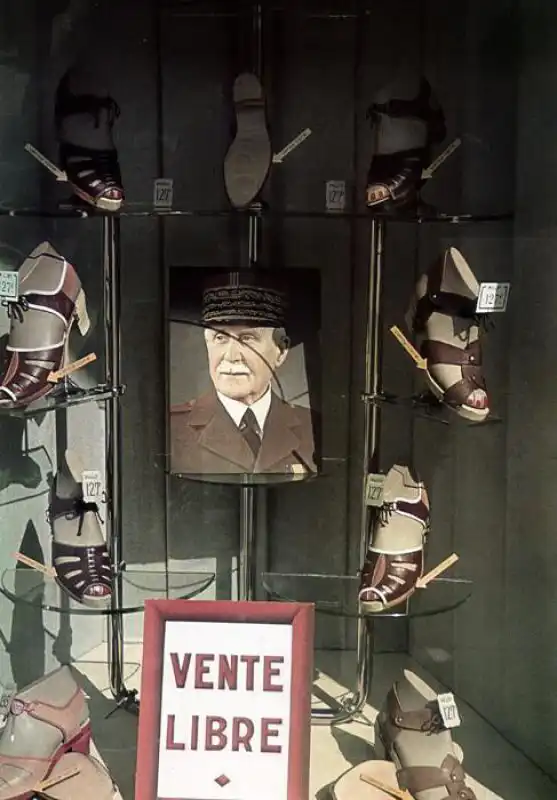
Famous color WWII photograph showing a shop window with a portrait of Marshal Pétain in occupied Paris during 1942.
Humor Under Occupation:
This famous color photograph from occupied Paris shows a shop window displaying a portrait of Marshal Philippe Pétain with the sarcastic inscription “Freely Available”.
The image is remarkable because it captures something deeply French even during wartime:
👉 irony
👉 sarcasm
👉 political humor
Despite occupation and censorship, Parisians often continued expressing criticism indirectly.
The Man in the Portrait – Philippe Pétain:
The portrait shows Philippe Pétain, the famous French marshal who became head of the Vichy regime after France’s defeat in 1940.
Before the war, Pétain had been celebrated as:
- A hero of World War I
- Defender of Verdun
- One of France’s most respected military figures
But after 1940 his reputation changed dramatically.
The Vichy Regime – Vichy France:
After the German victory over France in 1940, the country was divided.
The southern part became governed by the collaborationist regime known as Vichy France.
The government under Pétain cooperated with Nazi Germany through:
- Political collaboration
- Economic cooperation
- Anti-Jewish legislation
- Police assistance
For many French citizens, Pétain became a symbol of national humiliation.
“Freely Available” — A Dangerous Joke:
The sarcastic phrase beneath the portrait transforms the image into subtle political commentary.
The joke implied that:
👉 Pétain himself had become cheap
👉 His authority lacked dignity
👉 Collaboration was for sale
In occupied Paris, direct criticism could be dangerous.
Humor therefore became a safer weapon.
Parisian Irony During the Occupation:
French civilians developed many forms of quiet resistance:
- Political jokes
- Satirical comments
- Hidden insults
- Mockery of authorities
Even small acts of humor helped preserve:
- Personal dignity
- National identity
- Emotional resistance
Occupied Paris Was Full of Contradictions:
Photographs by André Zucca often show a city that appears calm and elegant.
But beneath the surface:
- Tension remained constant
- Political divisions deepened
- Collaboration and resistance coexisted
The occupation created a deeply fractured society.
The Photographer – André Zucca:
This image was taken by André Zucca, whose color wartime photographs became some of the most famous visual records of occupied Paris.
His work documented:
- Streets
- Markets
- Shops
- Everyday urban life
during one of the most controversial periods in modern French history.
Color Photography During World War II – Agfacolor:
Like many of Zucca’s photographs, this image was created using Agfacolor film technology.
Because color photography was still rare in the early 1940s, these images provide an unusually vivid impression of wartime Europe.
Public Opinion Toward Pétain:
French attitudes toward Pétain were complicated:
Some viewed him as:
- A protector trying to save France
Others saw him as:
- A collaborator
- A symbol of surrender
- A servant of Nazi Germany
By 1942, criticism of the regime had become increasingly common.
Small Acts of Resistance:
This photograph is important because it illustrates how resistance was not always armed.
Resistance could also appear through:
- Humor
- Symbols
- Language
- Public gestures
Even a sarcastic shop display could carry political meaning.
After the War:
Following the liberation of France:
- Pétain was arrested
- Tried for treason
- Convicted for collaboration
His historical legacy remains highly controversial in France to this day.
Historical Photograph Information:
Location: Paris, France
Date: 1942
Photographer: André Zucca
Recommended Books on Vichy France and Occupied Paris:
1. France Under the Germans — Julian Jackson
2. Vichy France — Robert Paxton
3. Paris After the Liberation — Antony Beevor & Artemis Cooper
4. The Collapse of the Third Republic — William Shirer