Historical September 1939 photograph showing a German Hauptfeldwebel posing with captured Polish soldiers and piled equipment near Lviv during the September Campaign.
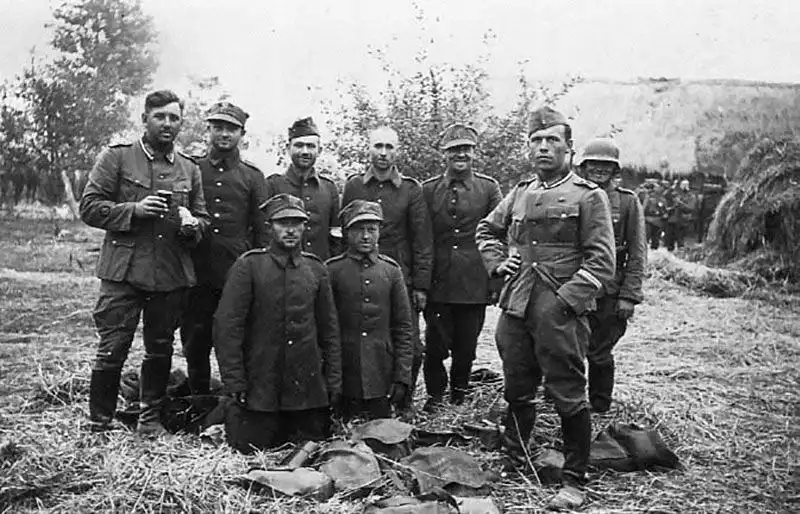
Wehrmacht Hauptfeldwebel and Captured Polish POWs Near Lviv (September 1939)
This detailed archival photograph taken in September 1939 during the Battle of Lwów (Lviv) captures a group of German soldiers posing with captured Polish prisoners of war alongside discarded military field equipment.
The scene illustrates the daily reality of early-war prisoner processing during the Invasion of Poland, highlighting notable details of Wehrmacht rank insignia, field gear, and Polish army uniforms.
Equipment, Uniforms, and Visual Features
The image contains several distinctive visual details regarding field uniforms, rank structure, and captured equipment:
- Company First Sergeant (Hauptfeldwebel): Standing prominently on the right is a Wehrmacht senior non-commissioned officer identifiable by the double silver braid rings (Kolbenringe) on his lower sleeves, denoting his status as a Hauptfeldwebel (company first sergeant or "Der Spieß").
- Tucked Reporting Notebook: The Hauptfeldwebel has a dispatch notebook or message pouch (Meldetasche) tucked securely into the front overlap of his M36 field tunic between the second and third buttons.
- Discarded Polish Field Gear: Piled on the ground in front of the prisoners are numerous Polish canvas breadbags (chlebaki wz. 33) and gas mask pouches, significantly outnumbering the captives present in the frame and indicating a larger disarmed unit.
- Polish Military Headgear: The Polish prisoners wear traditional soft field caps, including the iconic four-pointed rogatywka wz. 37 and standard issue side caps.
- Informal Moment: On the far left, a German NCO holds a drink and a slice of bread while observing the photo session, showcasing a brief pause during frontline processing.
Prisoner Processing During the 1939 Campaign
Following intense encirclement battles around Lviv, thousands of Polish troops surrendered to advancing Wehrmacht forces and approaching Red Army units. Standard German procedure involved immediate disarming, searching for intelligence materials, collecting personal field gear, and consolidating prisoners into makeshift collection points before marching them to rear-area POW camps (Stalag).
📍 Location: Lviv (Lwów), USSR / Ukraine
📅 Date: September 1939
📷 Photographer: Unknown
📰 Primary Source: Historical War Archive
Recommended reading:
- Wehrmacht rank structure: Role and sleeve insignia of the Hauptfeldwebel (Der Spieß)
- Polish army gear: Design and specifications of the rogatywka field cap and wz. 33 breadbag
- Battle of Lviv: Siege operations and capitulation of Polish forces in Eastern Galicia
- Uniformology: Insignia and equipment of early-war German non-commissioned officers