Action photograph from 1942 capturing a German Wehrmacht mountain trooper (Gebirgsjäger) with an ice axe and Kar98k rifle navigating a high-altitude Caucasus glacier.
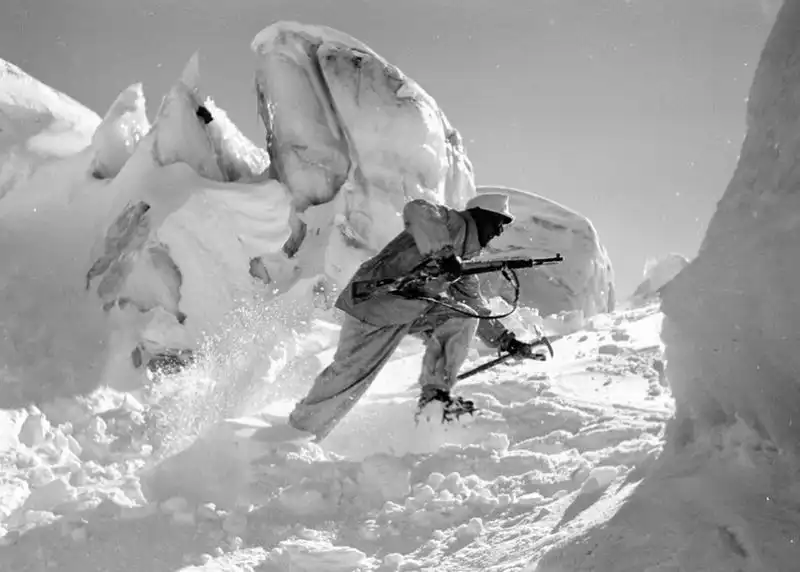
German Gebirgsjäger Navigating a Glacier in the Caucasus Mountains (1942)
This striking dynamic photograph taken in 1942 during Operation Edelweiss captures a German mountain trooper (Gebirgsjäger) traversing a steep, crevassed glacier field in the high-altitude reaches of the Caucasus Mountains.
Deployed during the Axis offensive toward the Caucasus oil fields, elite units such as the 1st Mountain Division (1. Gebirgs-Division) engaged Soviet defenders in some of the highest-altitude combat operations of World War II, operating at elevations exceeding 3,000 meters.
Equipment, Uniforms, and Visual Features
The image vividly details specialized alpine mountaineering equipment and snow gear utilized by German mountain troops:
- Mountaineering Tools: The trooper holds a standard military ice axe (Eispickel) in his left hand to maintain balance and secure footholds on the steep icy incline, while wearing heavy mountain boots (Bergschuhe) fitted with steel climbing crampons (Steigeisen).
- Glacier Protection: To prevent snow blindness caused by intense high-altitude ultraviolet radiation, the soldier wears specialized dark-tinted glacier goggles (Gletscherbrille) with protective side shields.
- Snow Camouflage: He wears a two-piece white snow camouflage oversuit (Schneeanzug) over his wool field tunic and windproof mountain smock (Windjacke).
- Standard Infantry Rifle: He carries a standard 7.92 mm bolt-action Karabiner 98k rifle equipped with its standard rear sight mechanism without specialized mountain elevation attachments.
- Glacier Landscape: The background reveals towering ice formations (seracs) and deep snowdrifts characteristic of the high Caucasus passes near Mount Elbrus.
High-Altitude Combat in Operation Edelweiss
Launched in July 1942, Operation Edelweiss aimed to capture the strategic Caucasus passes leading to the Black Sea coast and Transcaucasia. Soviet mountain infantry forces (Gorno-Strelkovy) fiercely contested key passes such as Klukhor, Marukh, and Sancharo. The extreme environmental conditions—avalanches, freezing blizzards, and treacherous glacier terrain—made alpine mountaineering skills as vital for survival as tactical combat proficiency.
📍 Location: Caucasus Mountains, USSR
📅 Date: 1942
📷 Photographer: Unknown (German War Correspondent / PK)
📰 Primary Source: Military Historical Archive
Recommended reading:
- Operation Edelweiss: Strategic objectives and high-altitude battles for the Caucasus passes (1942–1943)
- Alpine equipment: Uniforms, crampons, and specialized gear of the Wehrmacht Gebirgsjäger
- Soviet mountain defense: Tactics of Red Army mountain rifle brigades in the Greater Caucasus
- High-altitude logistics: Supply lines, pack mules, and air drops in high-mountain warfare