Archival September 1939 photograph showing German mountain infantry (Gebirgsjäger) passing an abandoned Polish twin-turret Vickers Mk.E Type A tank near Lviv.
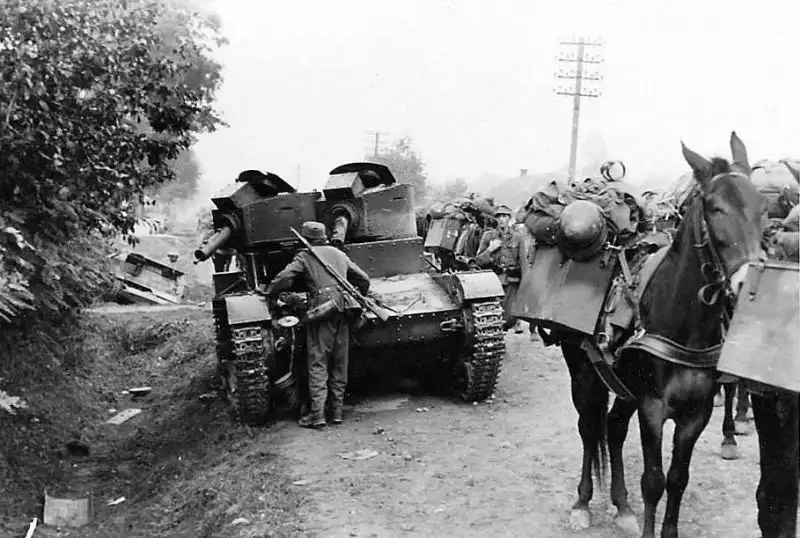
Abandoned Polish Twin-Turret Vickers Mk.E Tank Near Lviv (September 1939)
This remarkable archival photograph taken in September 1939 during the Battle of Lwów (Lviv) documents a column of German mountain troops (Gebirgsjäger) marching along a rural road past abandoned Polish armor, including a rare twin-turret Vickers Mk.E Type A light tank.
Purchased from Great Britain in the early 1930s, the Vickers 6-Ton tank formed the technical backbone of early Polish armored doctrine, undergoing numerous local armament experiments prior to the outbreak of World War II.
Equipment, Uniforms, and Visual Features
The photograph captures key tactical details of early-war Polish armor and German mountain infantry logistics during the September Campaign:
- Mixed Turret Armament: The twin-turret Vickers Mk.E Type A is configured with an infantry-support armament mix featuring a 37 mm wz.18 (SA-18) Puteaux short-barrel low-velocity gun in the right turret and a 7.92 mm wz.30 TMG (a water-cooled Colt-Browning variant) in the left turret.
- Armament Limitations: The low muzzle velocity of the 37 mm SA-18 gun rendered it ineffective against enemy armor, prompting Poland to experiment with 13.2 mm Hotchkiss heavy machine guns and eventually purchase 47 mm Vickers QF guns for single-turret conversions.
- German Mountain Troops (Gebirgsjäger): Soldiers from a German mountain division inspect the vehicle while marching alongside pack horses carrying gear, M1935 steel helmets (Stahlhelm M35), and equipment crates.
- Secondary Abandoned Armor: In the background on the far left, a second Polish armored vehicle sits disabled in a road embankment.
The Fall of Lviv and Polish Armored Operations
During the defense of Lviv in mid-September 1939, elements of the Polish 10th Motorized Cavalry Brigade and local defense units engaged advancing German 1st and 2nd Mountain Divisions. Faced with severe fuel shortages, mechanical breakdowns, and overwhelming air superiority, many Polish armored units were forced to scuttle or abandon their remaining light tanks along retreat routes toward the Hungarian and Romanian borders.
📍 Location: Lviv (Lwów), USSR / Ukraine
📅 Date: September 1939
📷 Photographer: Unknown
📰 Primary Source: Military Historical Archive
Recommended reading:
- Polish armor history: Development and field modifications of the Vickers Mk.E in Polish service
- Mountain infantry: Tactics and equipment of Wehrmacht Gebirgsjäger during the 1939 campaign
- Battle of Lviv: Defense operations and armored engagements in Southern Poland (1939)
- Interwar light tanks: The global influence of the British Vickers 6-Ton design