German forces destroy Soviet railway infrastructure with a Schienenwolf (“Rail Wolf”) track destroyer during their withdrawal from the Eastern Front in 1943.
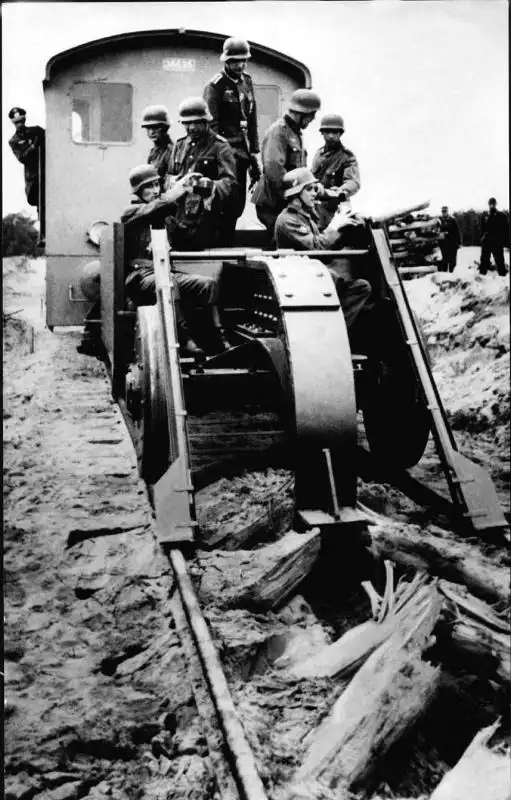
This remarkable wartime photograph shows one of the most unusual engineering devices employed during the Second World War. German troops are using a railway destruction machine known as the Schienenwolf (“Rail Wolf”) to systematically tear apart a Soviet railway line while retreating from occupied territories in 1943.
The image captures not a battle, but a different kind of warfare—an attempt to cripple transportation networks and slow the advance of the Red Army.
Scorched Earth on the Eastern Front:
By 1943 the strategic situation on the Eastern Front had changed dramatically. After the defeats at Stalingrad and during the summer campaigns of 1943, German forces increasingly found themselves abandoning territory that had been occupied during the rapid advances of 1941.
Whenever possible, retreating units attempted to leave behind a devastated landscape. Bridges were blown up, warehouses burned, roads mined, and railways deliberately destroyed.
The goal was simple: delay Soviet logistics and make it more difficult for the Red Army to pursue withdrawing German forces.
The Schienenwolf – “Rail Wolf”:
The machine visible in the photograph was officially a railway destruction device, but German soldiers gave it a much more memorable nickname—Schienenwolf, or “Rail Wolf.”
Mounted on a specially modified rail platform was a massive steel hook. Pulled by locomotives at a speed of approximately 7–10 kilometers per hour, the hook dug beneath the railway sleepers and ties.
As it advanced, the enormous force ripped up rails, shattered wooden sleepers, twisted fasteners, and left behind a trail of destruction that was difficult to repair quickly.
Unlike explosives, which could destroy only selected sections of track, the Rail Wolf could devastate long stretches of railway with remarkable efficiency.
A Weapon Against Logistics:
Railroads were the lifeline of warfare on the Eastern Front.
The immense distances of the Soviet Union made rail transport essential for moving troops, ammunition, fuel, food, and reinforcements. Both Germany and the Soviet Union depended heavily on railway networks to sustain military operations.
Because of this, railway destruction became a strategic objective. Every kilometer of ruined track meant additional delays for advancing forces and increased pressure on engineering units tasked with repairs.
The Schienenwolf was therefore not simply a piece of engineering equipment—it was a weapon directed against an enemy's ability to move and fight.
Engineering Simplicity and Efficiency:
One reason the Rail Wolf became famous was its simplicity.
Manufactured by Krupp beginning in 1942, the device could reportedly be prepared for operation in only a few minutes. A crew of around ten men was sufficient to operate it, making it an economical tool for large-scale destruction.
The machine represented a practical solution to a military problem: how to destroy infrastructure quickly while withdrawing under pressure.
Although crude in appearance, it proved highly effective and left a lasting impression on both German and Soviet railway engineers.
The Race to Restore the Railways:
Destroying railway tracks was only one side of the story.
Behind advancing Soviet troops came thousands of railway workers, engineers, and construction battalions whose job was to restore damaged lines as quickly as possible. Entire railway bridges were rebuilt, tracks relaid, and stations repaired under wartime conditions.
The struggle between destruction and reconstruction became an often-overlooked but crucial part of the war on the Eastern Front.
Photographs such as this remind us that victory depended not only on tanks and artillery, but also on the ability to move supplies across thousands of kilometers of territory.
A Rare Photograph of Wartime Engineering:
Many photographs from World War II depict combat, soldiers, and weapons. Far fewer show the logistical war that took place behind the front lines.
This image is valuable because it documents one of the most famous railway destruction devices ever built. The Schienenwolf stands as a symbol of Germany's retreat from the Soviet Union and of the immense importance of transportation infrastructure in modern warfare.
Photo data:
📍 Location: USSR
📅 Date: 1943
📷 Photographer: Unknown
Recommended Literature:
- Christian Wolmar — Blood, Iron and Gold: How Railways Transformed the World
- David Glantz — When Titans Clashed
- Earl F. Ziemke — Stalingrad to Berlin
- Robert Forczyk — The Eastern Front 1943–1945
- Walter S. Dunn Jr. — The Soviet Economy and the Red Army
- Steven J. Zaloga — The Red Army Handbook 1939–1945