Four German prisoners of war guarded by a Red Army soldier near Moscow in December 1941. The photograph reflects the harsh winter conditions and the changing fortunes of the Eastern Front.
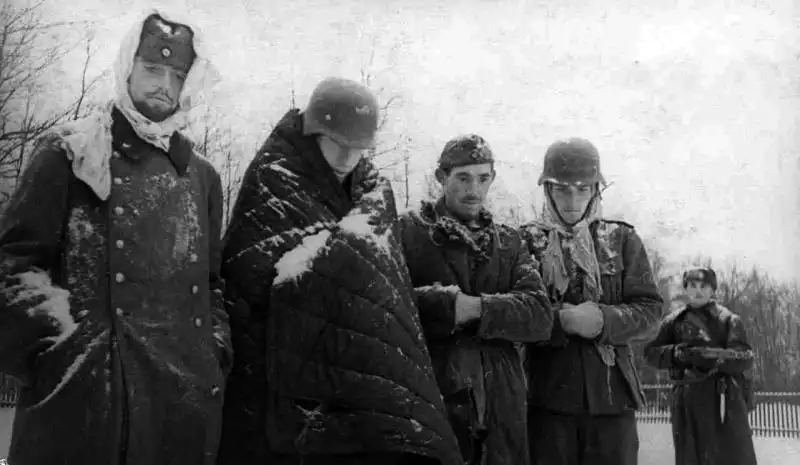
This photograph shows four German soldiers captured by the Red Army during the Soviet counteroffensive near Moscow in late December 1941. Guarded by a Soviet infantryman armed with a rifle, the prisoners stand as representatives of an army that only months earlier had appeared unstoppable.
Taken on December 29, 1941, the image captures a moment during one of the most important turning points of the Second World War.
The Battle for Moscow:
When Germany launched Operation Barbarossa in June 1941, many German commanders believed the Soviet Union would collapse within a few months.
By autumn, German forces had advanced deep into Soviet territory and approached Moscow itself. However, growing logistical problems, fierce Soviet resistance, and the arrival of winter gradually slowed the offensive.
In December 1941, the Red Army launched a massive counteroffensive that pushed German forces away from the Soviet capital. It was the first major strategic setback suffered by the Wehrmacht during the war.
Signs of the Winter Crisis:
One of the most interesting aspects of this photograph is the clothing worn by the prisoners.
Only one of the four German soldiers appears to be wearing proper winter clothing, while the others remain dressed largely in uniforms better suited to autumn conditions. Although this single image cannot represent the entire German Army, it reflects a wider problem faced by many Wehrmacht units during the winter of 1941–1942.
German planners had expected the campaign to end before the onset of severe cold weather. Instead, soldiers found themselves fighting through one of the harshest winters in decades, often lacking adequate cold-weather equipment.
The consequences were severe: frostbite, illness, and declining combat effectiveness affected large numbers of troops across the front.
A Rare Rifle in Soviet Service:
The Soviet guard is armed with an unusual rifle rather than the standard Mosin-Nagant typically associated with the Red Army.
The weapon appears to be a Belgian-designed Mauser-pattern rifle dating back to the late nineteenth century. During the war, the Soviet Union made use of a wide variety of rifles acquired from pre-war stockpiles, foreign purchases, wartime captures, and reserve depots.
The presence of such a weapon illustrates the enormous scale of the conflict and the diverse equipment that could still be encountered on the battlefield.
Four Prisoners, A Larger Story:
The small number of prisoners visible in the photograph is also noteworthy.
Unlike the massive German surrenders that would occur later in the war, particularly after Stalingrad, the Wehrmacht in late 1941 remained a dangerous and capable fighting force despite its setbacks. German units were retreating in many sectors, but they continued to resist fiercely and maintained considerable combat effectiveness.
For this reason, every captured soldier represented a hard-won success for Soviet troops.
The Beginning of a Long Road:
The men in this photograph could not have known that the war would continue for more than three additional years.
At the moment this image was taken, neither side could foresee the immense battles still to come: Stalingrad, Kursk, Operation Bagration, and the final assault on Berlin.
Yet photographs like this capture the moment when the myth of German invincibility first began to crack. The Soviet counteroffensive before Moscow demonstrated that the Wehrmacht could be stopped and pushed back.
A Snapshot of a Turning Point:
More than a simple prisoner photograph, this image preserves a crucial moment in military history.
It shows exhausted soldiers, harsh winter conditions, and the changing balance of power on the Eastern Front. The Battle of Moscow did not end the war, but it marked the beginning of Germany's long retreat from the Soviet Union.
Photo data:
📍 Location: Moscow Region, USSR
📅 Date: December 29, 1941
📷 Photographer: Anatoly Garanin
Recommended Literature:
- David Glantz — Barbarossa Derailed: The Battle for Moscow
- Rodric Braithwaite — Moscow 1941: A City and Its People at War
- Robert Forczyk — Moscow 1941: Hitler's First Defeat
- John Erickson — The Road to Stalingrad
- Earl F. Ziemke — Moscow to Stalingrad
- Antony Beevor — The Second World War