German soldiers search a captured Red Army soldier, May 1942. A stark WWII image showing the reality of captivity on the Eastern Front.
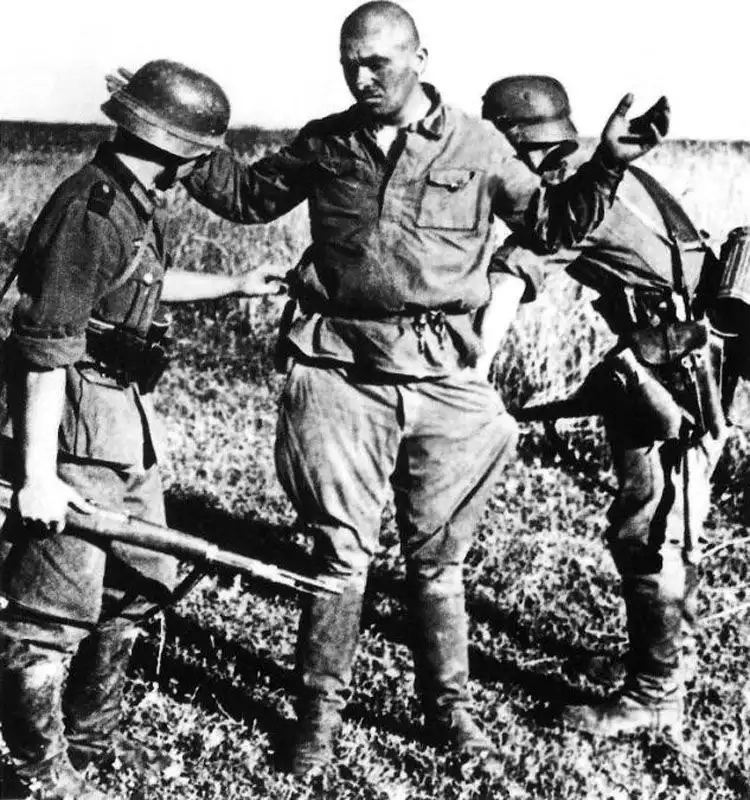
A Moment of Capture:
This photograph shows German soldiers searching a captured Red Army soldier in May 1942, in the Rzhev-Vyazma salient.
There is no movement, no visible struggle.
The moment has already passed —
the soldier has been captured.
What remains is procedure.
The Act of Search:
The search of a prisoner was a standard military practice.
It served several purposes:
- Removing weapons
- Collecting documents
- Identifying the individual
- Ensuring the prisoner posed no threat
But beyond its practical function, it also symbolized something deeper:
👉 Total loss of control
The captured soldier is no longer a combatant.
He is now entirely dependent on his captors.
The Eastern Front Context:
The image was taken during fighting in the Rzhev battles, one of the most brutal and costly sectors of the Eastern Front.
The Rzhev salient was known for:
- Continuous offensives and counteroffensives
- Extremely high casualties
- Harsh environmental conditions
Both sides suffered enormous losses in this region.
The Reality of Captivity:
For Soviet soldiers captured in 1941–1942, the situation was often dire.
Conditions in German POW camps were:
- Harsh and overcrowded
- Lacking sufficient food
- Poor in medical care
Survival rates among Soviet prisoners during this period were extremely low.
This gives the image an additional weight —
we know what may follow.
A Human Turning Point:
This photograph captures a critical transition:
From:
- Armed soldier
- Member of a unit
- Participant in battle
To:
- Prisoner
- Isolated individual
- Uncertain fate
It is one of the most profound transformations in war.
No Heroism, Only Reality:
There is no action here.
No dramatic movement.
Only:
- A man being searched
- Others standing over him
This stillness makes the image more powerful.
It forces the viewer to confront the quieter, often overlooked moments of war.
The Rzhev Sector:
The Rzhev-Vyazma region became one of the bloodiest areas of the war.
Often referred to as:
- “The Rzhev Meat Grinder”
It saw:
- Repeated Soviet offensives
- Strong German defensive positions
- Enormous human cost on both sides
The photograph is one small fragment of that larger tragedy.
Historical Photograph Information:
Location: Rzhev region, USSR
Date: May 1942
Photographer: Unknown
Recommended Books on the Eastern Front and POW Experience:
1. Ivan’s War — Catherine Merridale
2. The Eastern Front 1941–1945 — David Stahel
3. Rzhev 1942–43 — Prit Buttar
4. Hitler’s Army — Omer Bartov