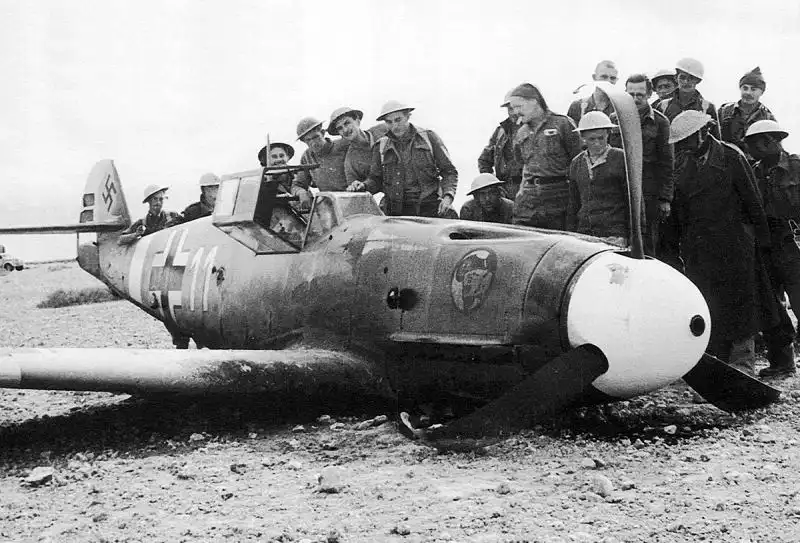
German fighter pilot Albert Espenlaub’s Bf 109F-2 Trop after a forced landing in Libya, 1941. A dramatic WWII image of survival, capture, and fate.
A Fighter Brought Down:
This photograph shows a Messerschmitt Bf 109F-2 Trop after a forced landing on December 13, 1941, near El Adem, Libya.
The aircraft is damaged but intact.
Oil streaks run along the fuselage.
The fight is over —
but the story is not.
The Pilot – Albert Espenlaub:
The aircraft belonged to Albert Espenlaub, an Oberfeldwebel serving in 1./JG 27, a German fighter unit operating in North Africa.
By the time of this incident, Espenlaub had:
- Scored 14 aerial victories
- Gained combat experience in the desert campaign
On this day, however, his luck ran out.
What Happened in the Air:
During an aerial engagement, Espenlaub’s aircraft suffered damage to its engine cooling system.
For any piston-engine fighter, this was critical:
- Engine overheating becomes inevitable
- Continued flight risks total engine failure
The pilot had no choice but to attempt an emergency landing.
The Aircraft – Messerschmitt Bf 109F-2 Trop:
The aircraft is a Messerschmitt Bf 109F-2 Trop, a tropicalized version of the Bf 109 designed for desert operations.
Key features included:
- Sand filters for engine protection
- Adaptations for extreme heat and dust
- High performance despite harsh conditions
Even so, combat damage could quickly render the aircraft uncontrollable.
The Forced Landing:
Espenlaub managed to land successfully —
a difficult task under combat conditions.
The aircraft remained largely intact, as seen in the photograph.
However, there was one critical detail:
👉 He landed in enemy-controlled territory
He survived the landing —
but immediately became a prisoner of war.
A Plane Stripped of Victory Marks:
A striking detail in the image is the missing fabric on the rudder, where victory markings had been painted.
These marks represented:
- Confirmed aerial kills
- Personal achievements of the pilot
Their removal suggests that:
- Allied soldiers cut them out
- Possibly as souvenirs
Even in war, small pieces of history were taken as trophies.
The Oil Stains:
Visible oil streaks along the fuselage confirm the reported damage.
They indicate:
- Loss of engine fluids
- Mechanical failure in progress
This detail connects the visual evidence directly to the events of the air battle.
The Final Fate:
After his capture, Espenlaub became a prisoner of war.
But his story did not end there.
On February 25, 1942, he was killed during an escape attempt from a POW camp.
From experienced fighter pilot
to captive
to a fatal attempt at freedom.
A short, brutal trajectory.
War Beyond the Battle:
This photograph shows more than a damaged aircraft.
It represents:
- The thin line between survival and capture
- The unpredictability of combat
- The human cost behind every machine
Victory in the air did not guarantee survival on the ground.
Historical Photograph Information:
Location: El Adem, Libya
Date: December 13, 1941
Photographer: Unknown
Recommended Books on Air War in North Africa:
1. Fighters Over the Desert — Christopher Shores
2. JG 27: Top Guns of the Luftwaffe — John Weal
3. War in the Desert — Alan Moorehead
4. The German Aces Speak — Colin Heaton