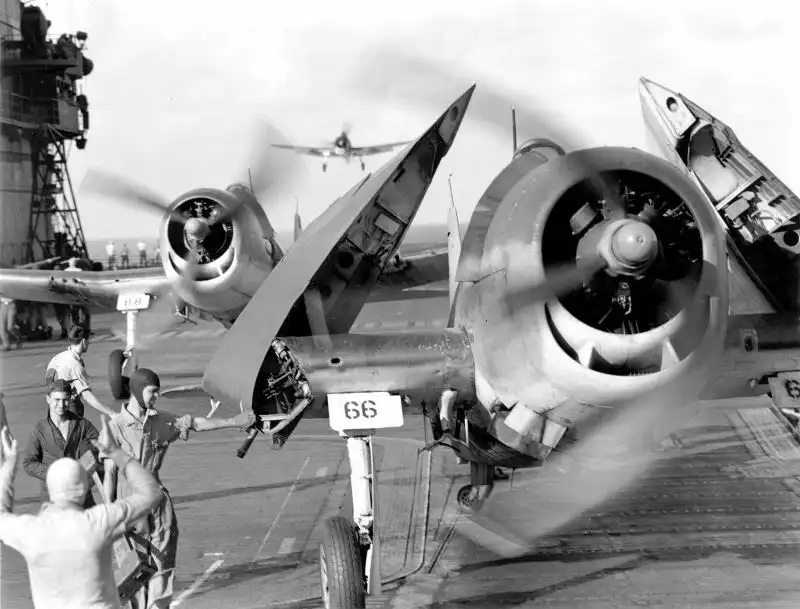
F6F-3 Hellcat fighters land on USS Enterprise after strikes on Truk, February 1944. A vivid WWII scene of carrier aviation in action.
Return from Combat:
This photograph shows multiple U.S. Navy F6F-3 Hellcat fighters landing on the aircraft carrier USS Enterprise on February 16, 1944, after participating in air strikes against the Japanese base at Truk.
The mission is over.
The pilots are returning.
But even now, the danger is not gone.
The Aircraft – Grumman F6F Hellcat:
The aircraft in the image are Grumman F6F Hellcat fighters, the backbone of U.S. Navy carrier aviation in the Pacific War.
By 1944, the Hellcat had proven itself as:
- Highly durable
- Easy to fly compared to earlier fighters
- Extremely effective against Japanese aircraft
It became one of the most successful naval fighters of World War II.
The Carrier – USS Enterprise (CV-6):
The landings are taking place aboard the USS Enterprise (CV-6), one of the most famous aircraft carriers of the war.
Known as the “Big E,” the Enterprise played a key role in:
- Major Pacific campaigns
- Carrier strike operations
- Air superiority missions
By early 1944, it was at the center of offensive operations against Japanese positions.
Operation Against Truk:
These aircraft are returning from strikes on Truk Lagoon, one of Japan’s most important naval bases in the Pacific.
The attacks were part of a large-scale U.S. operation aimed at:
- Destroying Japanese ships
- Crippling logistics and supply
- Neutralizing a major strategic stronghold
Truk was often referred to as the “Gibraltar of the Pacific.”
Landing: Still Dangerous:
Carrier landings were among the most difficult tasks for pilots.
Even after surviving combat, they still had to:
- Approach a moving deck
- Catch arresting wires precisely
- Avoid collisions with other aircraft
A mistake could mean:
- Crash landing
- Fire on deck
- Death
Returning safely was never guaranteed.
Deck Crew in Action:
One of the most fascinating elements in the image is the deck crew.
After landing:
- Aircraft wings are folded to save space
- Ground personnel quickly move planes
- Every second matters
This process allowed carriers to:
- Recover multiple aircraft rapidly
- Prepare for the next wave of operations
It was a perfectly coordinated system.
The Machinery of War:
This image represents something bigger than individual heroism.
It shows:
- Organization
- Discipline
- Industrial-scale warfare
Each landing aircraft is part of a larger machine:
👉 Pilots
👉 Crew
👉 Engineers
👉 Command
All working together with precision.
A Controlled Chaos:
The flight deck during recovery operations was:
- Loud
- Crowded
- Extremely dangerous
Engines running, signals being shouted, aircraft moving —
And yet, everything followed a strict order.
This balance between chaos and control defined carrier warfare.
Historical Photograph Information:
Location: Pacific Ocean
Date: February 16, 1944
Photographer: Unknown
Source of the Photograph:
U.S. National Archives (80-G-59314)
Recommended Books on Pacific Carrier Warfare:
1. The Fast Carriers — Clark G. Reynolds
2. Hellcat: The F6F in World War II — Barrett Tillman
3. The Big E — Edward Stafford
4. Shattered Sword — Jonathan Parshall & Anthony Tully