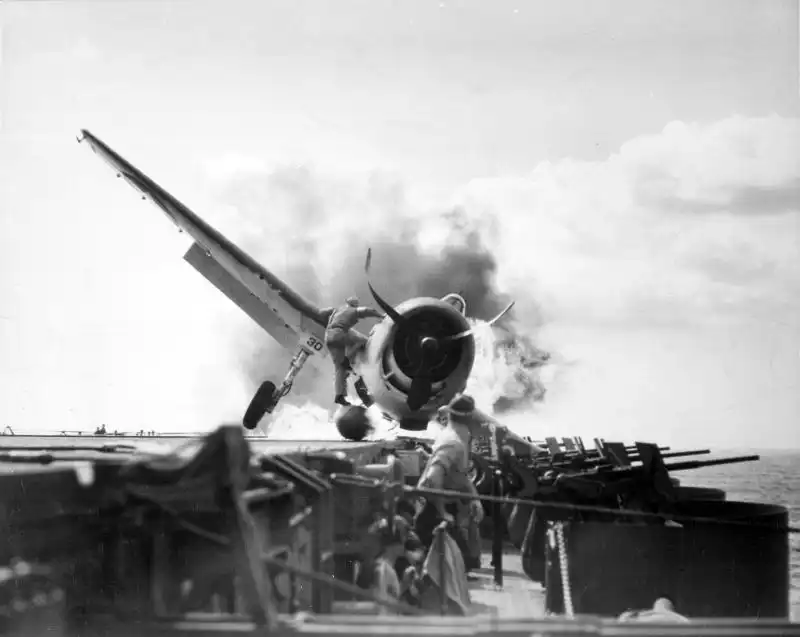
A dramatic emergency landing of an F6F-3 Hellcat on USS Enterprise, November 1943. A burning aircraft and a daring rescue at sea during WWII.
A Split-Second Between Life and Death:
This powerful photograph captures the moment of an emergency landing of a U.S. Navy F6F-3 Hellcat on the aircraft carrier USS Enterprise on November 10, 1943.
The aircraft is already on fire.
Flames consume the fuselage, and the situation is critical.
Inside the cockpit — the pilot is trapped.
And on the wing, a man is climbing toward the fire.
The Aircraft – Grumman F6F Hellcat:
The aircraft involved is a Grumman F6F Hellcat, one of the most important U.S. Navy fighters of World War II.
Key features:
- Designed for carrier operations
- Powerful engine and rugged construction
- Effective against Japanese aircraft in the Pacific
This particular aircraft, marked with side number 30, belonged to Fighter Squadron VF-2.
The Carrier – USS Enterprise (CV-6):
The landing took place aboard the legendary USS Enterprise (CV-6), one of the most decorated ships of World War II.
By late 1943, the Enterprise had already participated in multiple major operations in the Pacific and continued to play a central role in U.S. naval aviation.
At the time of this event, the carrier was heading toward Makin Atoll in the Gilbert Islands to support ongoing operations.
What Happened:
The fighter was forced to make an emergency landing due to engine failure.
During the landing:
- The aircraft struck the deck
- A fire broke out immediately
- The cockpit canopy jammed
The pilot, Byron M. Johnson, was trapped inside the burning aircraft.
The Rescue:
At this critical moment, Walter L. Chewning Jr., a catapult officer, rushed forward.
He did something few would dare:
- Climbed onto the burning aircraft
- Reached the cockpit
- Forced it open
The exact moment of this rescue is captured in the photograph.
Thanks to his actions, the pilot was able to escape.
Remarkably, Byron Johnson survived without serious injuries.
The Danger of Carrier Operations:
Aircraft carrier landings were among the most dangerous tasks in wartime aviation.
Pilots faced:
- Short landing decks
- Moving surfaces
- High approach speeds
- Immediate risk of fire upon crash
Even a minor malfunction could turn into a life-threatening situation — as seen in this image.
Fuel and Fire:
The aircraft was carrying an external fuel tank, increasing the danger significantly.
Fuel fires were one of the greatest risks on carrier decks:
- Rapid spread of flames
- Explosion risk
- Threat to crew and nearby aircraft
This made the rescue even more dangerous.
A Moment of Courage:
What makes this photograph unforgettable is the human element.
In the middle of chaos:
- One man runs toward danger
- Not away from it
There is no hesitation.
No visible fear.
Just action.
Historical Photograph Information:
Location: Pacific Ocean
Date: November 10, 1943
Photographer: Unknown
Source of the Photograph:
Recommended Books on Carrier Warfare in WWII:
1. The Fast Carriers — Clark G. Reynolds
2. Carrier Pilot — Norman Hanson
3. Hellcat: The F6F in World War II — Barrett Tillman
4. The Big E — Edward Stafford