A Soviet naval infantryman armed with a captured German MP 38/40, 1941. A striking WWII image showing adaptation and survival on the Eastern Front.
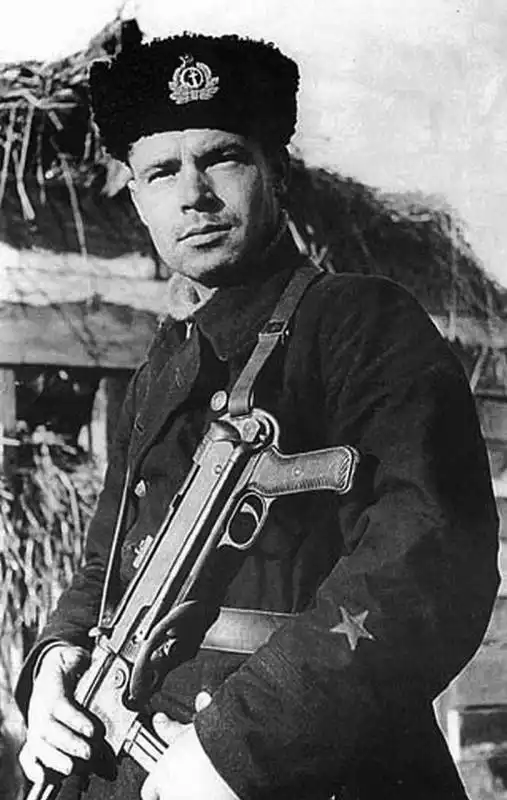
A Fighter with an Unusual Weapon:
This photograph shows a Soviet naval infantryman armed with a captured German MP 38/40 submachine gun on the front line in 1941.
At first glance, it may seem like a simple portrait of a soldier.
But one detail stands out immediately —
the weapon in his hands is not Soviet.
The Soldier – A Red Navy Rifleman:
The man in the image is a Red Navy serviceman (Krasnoflotets) from the 75th Separate Naval Rifle Brigade.
Naval infantry units of the Soviet Union were often deployed as elite ground troops, especially in critical sectors of the front.
They were known for:
- High morale and discipline
- Distinctive naval uniforms
- Frequent use in defensive and assault operations
Despite being sailors by training, many fought as infantry under some of the harshest conditions of the war.
The Weapon – MP 38/40:
The soldier is holding a MP 38/40, one of the most recognizable German firearms of World War II.
Key features:
- Chambered for 9×19mm Parabellum
- Compact and relatively lightweight
- Effective in close-range combat
Compared to early-war Soviet submachine guns, the MP 38/40 was:
- Easier to handle
- More ergonomic
- Highly valued as a captured weapon
Captured Weapons in the Red Army:
In 1941, the Soviet Union faced severe equipment shortages during the early stages of the war.
As a result:
- Captured German weapons were widely used
- Soldiers often relied on whatever was available
- Ammunition compatibility became a practical concern
Using enemy weapons was not unusual —
it was often a matter of survival.
The Eastern Front, 1941:
The photograph dates to 1941, during the early phase of Operation Barbarossa.
At this time:
- German forces were advancing rapidly
- Soviet units were under immense pressure
- Front lines were fluid and chaotic
In such conditions, adaptability was critical.
A soldier with a captured weapon represents that reality perfectly.
Naval Infantry in Ground Combat:
The 75th Separate Naval Rifle Brigade was one of several naval infantry units formed to reinforce land defenses.
These units were often deployed:
- In key defensive battles
- In urban combat zones
- In high-risk operations
Naval infantry earned a reputation for resilience and determination, often fighting in situations where regular units had already been exhausted.
A Symbol of Adaptation:
This image reflects a broader truth of war:
Standardization breaks down under pressure.
Instead:
- Soldiers improvise
- Equipment is reused
- Survival overrides doctrine
A Soviet sailor holding a German weapon is not an anomaly —
it is a symbol of battlefield reality.
The Human Element:
Beyond the weapon and uniform, the photograph captures something more important:
A single individual in the middle of a massive conflict.
We do not know his name.
We do not know his fate.
But in this moment, he stands ready —
armed, alert, and part of a war that would define his generation.
Historical Photograph Information:
Location: USSR
Date: 1941
Photographer: Unknown
Recommended Books on the Eastern Front and Infantry Weapons:
1. Ivan’s War — Catherine Merridale
A deep look into the lives of Soviet soldiers.
2. The Red Army at War — Artem Drabkin
First-hand accounts from the front.
3. Weapons of World War II — Chris McNab
Overview of firearms used in the war.
4. Stalingrad — Antony Beevor
Context of early war struggles and adaptation.