German Panzer III tanks ford a river during the rapid advance into the Soviet Union in the summer of 1941. Spare road wheels from Czech-built tanks can be seen mounted on the rear of the vehicles.
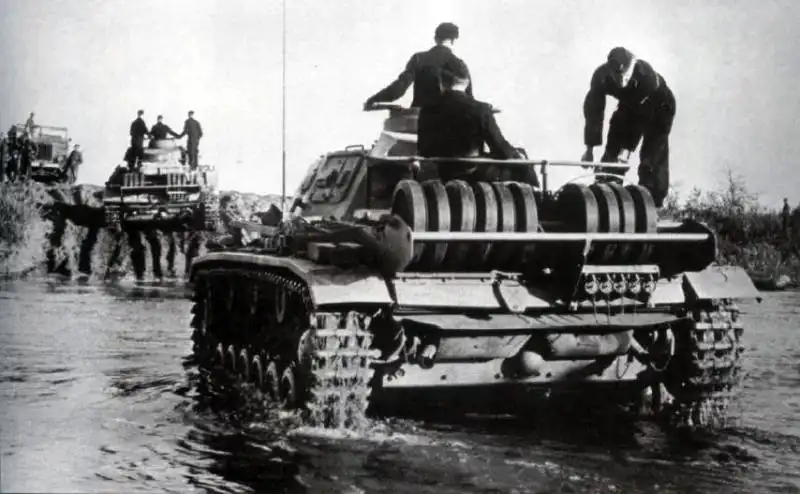
A column of German Panzer III tanks crosses a water obstacle during the opening months of the German invasion of the Soviet Union in the summer of 1941. The photograph captures a typical scene from the fast-moving campaign known as Operation Barbarossa, when armored spearheads advanced hundreds of kilometers into Soviet territory.
The vehicles visible in the image appear to be either standard Panzer III medium tanks or command variants known as Panzerbefehlswagen III, which were equipped with additional radio equipment for battlefield command and control.
Armored Warfare and Mobility:
One of the keys to the early successes of the German army in 1941 was mobility. Armored formations were expected to advance rapidly across vast distances while maintaining contact with supporting infantry, artillery, and supply columns.
Rivers, streams, marshes, and damaged bridges frequently interrupted this advance. Tank crews therefore spent much of their time overcoming natural obstacles rather than fighting enemy armor.
Photographs like this demonstrate the practical realities of mechanized warfare. Crossing even a relatively shallow river required skill, coordination, and confidence in both the vehicle and its crew.
The Panzer III: Germany's Main Battle Tank of 1941:
At the start of Operation Barbarossa, the Panzer III formed the backbone of Germany's armored forces. Designed primarily to fight enemy tanks, it was armed with a 50 mm gun in most frontline units by 1941 and was operated by a five-man crew.
Although later overshadowed by the Panther and Tiger, the Panzer III was arguably the most important German tank during the first half of the war. Thousands served on every major front, from North Africa to the Soviet Union.
During the summer battles of 1941, Panzer III units participated in some of the largest encirclement operations in military history, helping trap entire Soviet armies in Belarus, Ukraine, and western Russia.
An Interesting Detail: Czech Spare Road Wheels:
The most unusual feature visible in this photograph is the presence of spare rubber-rimmed road wheels mounted on the rear of the tanks.
These wheels appear to originate from the Czech-built Pz.38(t), a tank inherited by Germany after the occupation of Czechoslovakia. The Wehrmacht made extensive use of captured Czech armored vehicles and their spare parts during the early years of the war.
The reason these wheels are being carried remains uncertain. They may have been transported as spare components for maintenance units, salvaged from damaged vehicles, or simply used as additional cargo storage. Whatever the explanation, the detail serves as a reminder of the diverse origins of German armored equipment in 1941.
The Summer of Victories:
When this photograph was taken, German forces were still advancing deep into Soviet territory. Many officers and soldiers believed victory was only a matter of time.
Yet behind the apparent confidence of these armored columns lay enormous challenges. Supply lines were stretching ever farther east, mechanical wear was increasing, and Soviet resistance was gradually hardening.
Within months, the Wehrmacht would face the first major setbacks of the campaign as the advance slowed before Moscow and the realities of a long war became impossible to ignore.
A Snapshot of the Blitzkrieg Era:
This image perfectly captures the character of the early Eastern Front: mobile warfare, confident armored formations, and the relentless movement eastward that defined the summer of 1941.
It is also a valuable technical photograph, preserving details of German equipment and field improvisations that are often overlooked in broader histories of the war.
Photo data:
📍 Location: USSR
📅 Date: Summer 1941
📷 Photographer: Unknown
Recommended Literature:
- Thomas L. Jentz — Panzertruppen Volume 1
- Steven J. Zaloga — German Panzers 1914–1945
- Karl-Heinz Frieser — The Blitzkrieg Legend
- Robert Forczyk — Moscow 1941
- David Glantz — Barbarossa: Hitler's Invasion of Russia 1941
- Walter J. Spielberger — Panzerkampfwagen III and Its Variants