Archival photo from summer 1941 analyzing a destroyed Soviet BT-7 light tank with front armor penetration during the initial phase of Operation Barbarossa.
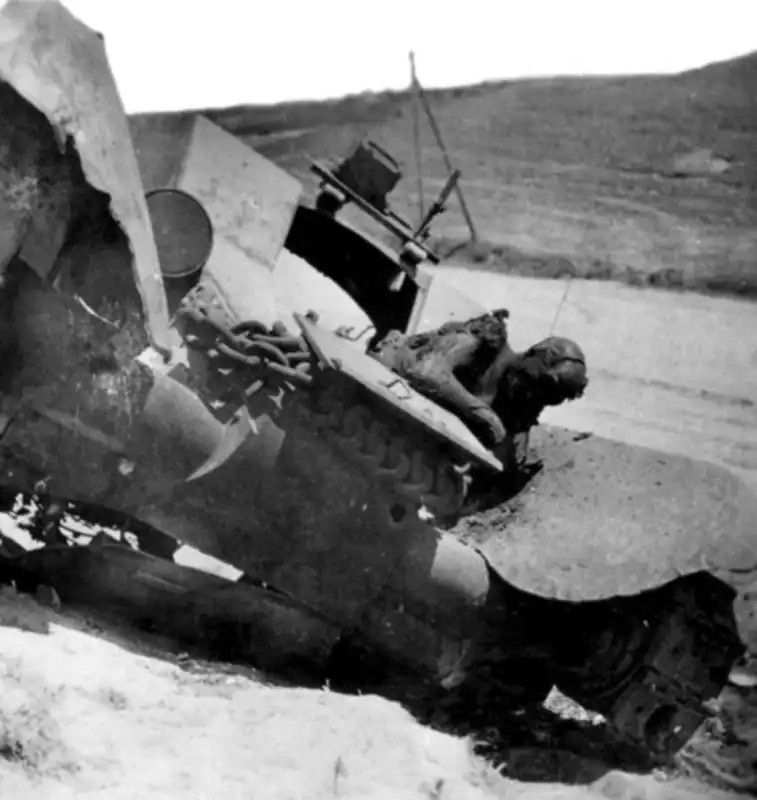
Technical Analysis: Destroyed Red Army BT-7 Light Tank (Summer 1941)
This historical photograph from the summer of 1941 depicts a destroyed Soviet BT-7 light tank following armored engagements during the opening months of Operation Barbarossa on the Eastern Front.
The image highlights the severe vulnerabilities of light cavalry tanks when facing organized infantry anti-tank defenses and direct artillery fire during the heavy border clashes of June and July 1941.
Equipment, Armor, and Visual Features
The photograph provides specific technical insights into the construction and combat survivability of the BT-7 fast tank:
- Frontal Armor Penetration: The forward hull section displays a distinct penetration mark caused by an armor-piercing shell, likely fired by a German 3.7 cm Pak 36 or 5 cm Pak 38 anti-tank gun.
- Driver Position and Hatch: The forward driver's hatch is shown in the open position. Positioned directly behind the frontal armor plate, the driver's compartment offered extremely limited space for rapid emergency egress.
- Armor Specifications: The BT-7 design prioritized high speed (up to 72 km/h on tracks) over heavy protection, utilizing rolled homogeneous armor plates ranging from 6 mm to 20 mm in thickness—sufficient only against small arms fire and shell splinters.
- Fire Hazards: Powered by a Mikulin M-17T aviation-derived gasoline engine, light tanks of the BT series were highly susceptible to rapid fuel ignition upon armor penetration.
Historical Context: Mechanized Corps in 1941
During the summer of 1941, the Red Army's mechanized corps possessed thousands of BT-5 and BT-7 light tanks. While numerically superior, these units faced technical shortcomings, lack of repair recovery vehicles, acute ammunition shortages, and strong enemy anti-tank screens during counterattacks in Ukraine, Belarus, and the Baltic region, leading to massive armor losses during the campaign's initial phase.
📍 Location: USSR (Eastern Front)
📅 Date: Summer 1941
📷 Photographer: Unknown (German / Soviet War Correspondent)
📰 Primary Source: Military Historical Armor Archives
Recommended reading:
- Red Army Mechanized Corps: Organization and combat operations in June 1941
- BT-7 Technical History: Development, armor specifications, and operational deployment
- Wehrmacht Anti-Tank Tactics: Performance of Pak 36 and Pak 38 against Soviet armor
- Battle of Brody (1941): The largest tank battle of the opening phase of the Eastern Front