Archival photo from November 1941 depicting a Soviet infantryman armed with an SVT-40 rifle, RPG-40 anti-tank grenades, and incendiary bottles during the Battle of Moscow.
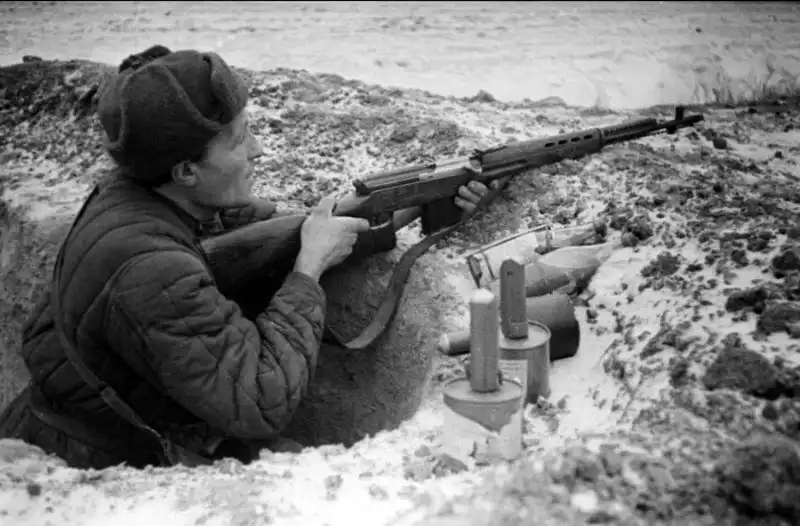
Red Army Infantryman with SVT-40 Rifle in Defensive Position (November 1941)
This dynamic historical photograph taken in November 1941 captures a Soviet Red Army infantryman occupying a defensive foxhole on a tank-threatened sector during the crucial period of the Battle of Moscow.
As German forces launched their final autumn offensive toward the Soviet capital (Operation Typhoon), Red Army rifle units prepared multi-layered anti-tank defenses combining semi-automatic firepower, specialized anti-tank hand grenades, and improvised incendiary devices.
Equipment, Infantry Weapons, and Visual Features
The photograph offers a comprehensive look at the individual infantry and anti-tank weaponry issued to Soviet soldiers in late 1941:
- SVT-40 Semi-Automatic Rifle: The infantryman aims a 7.62×54mmR SVT-40 (Samozaryadnaya Vintovka Tokareva), equipped with a 10-round detachable box magazine, slotted muzzle brake, and ventilated metal handguard upper casing.
- RPG-40 Anti-Tank Grenades: Placed ready on the dirt parapet are RPG-40 high-explosive anti-tank hand grenades. Weighing 1,200 grams and containing 760 grams of TNT, the RPG-40 was designed to breach up to 20–25 mm of armor plate upon contact.
- Incendiary "Molotov" Bottles: Alongside the grenades lie glass incendiary bottles filled with combustible "KS" fluid, serving as close-range anti-tank measures against engine grilles and vision slits.
- Winter Uniform Issue: The soldier wears a standard quilted padded jacket (telogreika / vatnik) and a winter fur cap (ushanka), essential for enduring the freezing November conditions around Moscow.
Historical Context: Anti-Tank Defense in the Battle of Moscow
During the intense defensive battles along the Mozhaisk Defense Line and surrounding approaches to Moscow in November 1941, Red Army infantry regiments faced massive armor thrusts by German Panzer groups. Due to shortages of heavy towed anti-tank artillery, infantrymen relied heavily on close-range weapons, including RPG-40 grenades, anti-tank rifles (PTRD/PTRS), and incendiary bottles to halt enemy armored advances.
📍 Location: Moscow Region, RSFSR, USSR
📅 Date: November 1941
📷 Photographer: Unknown (Soviet Military Correspondent)
📰 Primary Source: Central Museum of the Armed Forces of the Russian Federation
Recommended reading:
- SVT-40 Development: Design, mechanics, and service history of the Tokarev semi-automatic rifle
- Battle of Moscow (1941): Red Army defensive operations during Operation Typhoon
- Soviet Anti-Tank Hand Grenades: Evolution from RPG-40 to shaped-charge RPG-43
- Infantry Anti-Tank Tactics: Close-range defense methods against Axis armor on the Eastern Front