Historical archival photograph of a six-engined German Messerschmitt Me 323 "Gigant" heavy transport aircraft during takeoff in Germany.
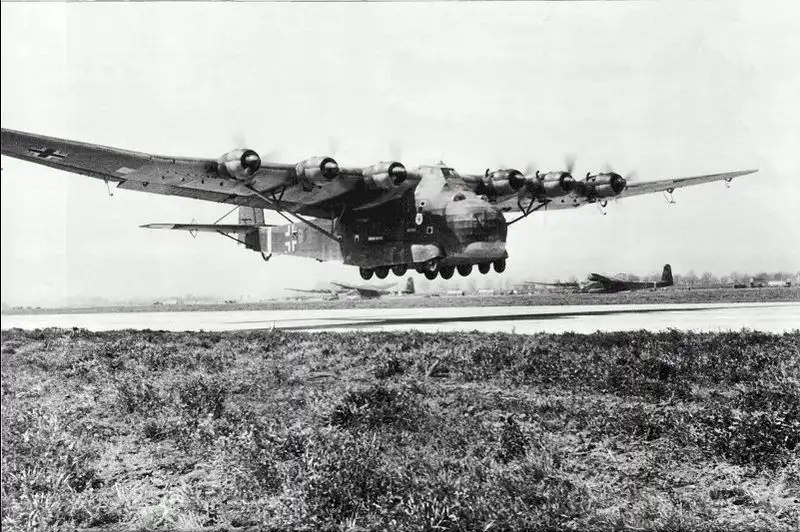
Takeoff of the Messerschmitt Me 323 "Gigant" Heavy Transport Aircraft
This striking archival photograph from the German Federal Archives (Bundesarchiv Bild 101I-596-0367-05A), taken by war correspondent Menzendorf, captures a massive Messerschmitt Me 323 "Gigant" heavy transport aircraft lifting off from an airfield in Germany.
As the largest land-based transport aircraft to operational deployment during World War II, the Me 323 represented a unique effort by the Luftwaffe to create an ultra-heavy airlift capability for oversized equipment, vehicles, and troop movements.
Design and Technical Evolution
The Me 323 was developed directly from the Me 321 heavy cargo glider, which originally required specialized tug aircraft (such as the Heinkel He 111Z Zwilling) or rocket-assisted takeoff units to get airborne:
- Six-Engine Powerplant: To achieve self-sufficiency, designers mounted six captured French Gnome-Rhône 14N 14-cylinder radial engines onto the reinforced fabric-and-plywood wing structure.
- Multi-Wheel Landing Gear: The distinctive 10-wheel tandem chassis was designed to distribute the massive aircraft's weight evenly across rough, unpaved frontline airfields.
- Payload Capacity: The aircraft's clamshell nose doors opened to a spacious cargo hold capable of carrying up to 130 fully equipped soldiers, an 88 mm Flak gun with its tractor, or a light armored vehicle weighing up to 12 metric tons.
- Production Chronology Note: While some archival index records reference 1941 (the development period of the initial glider variant and four-engine prototype), full flight operations of the six-engine Me 323 series officially began in 1942.
Operational History in WWII
Though invaluable for ferrying critical supplies across the Mediterranean to Tunisia and along the Eastern Front, the Me 323's low top speed (around 218 km/h) and large radar cross-section made it extremely vulnerable to Allied fighter interception, leading to heavy losses during supply missions in 1943.
📍 Location: Germany
📅 Date: 1942
📷 Photographer: Menzendorf (Propaganda Company / PK)
📰 Primary Source: Bundesarchiv (Bild 101I-596-0367-05A)
Recommended reading:
- Me 321 to Me 323 Conversion: How Germany motorized giant military gliders
- Gnome-Rhône 14N Engines: The use of captured French aviation industry in Luftwaffe design
- Luftwaffe Air Supply in North Africa: The tragic fate of Me 323 transport convoys in 1943
- Heinkel He 111Z Zwilling: The five-engine double-fuselage glider tug