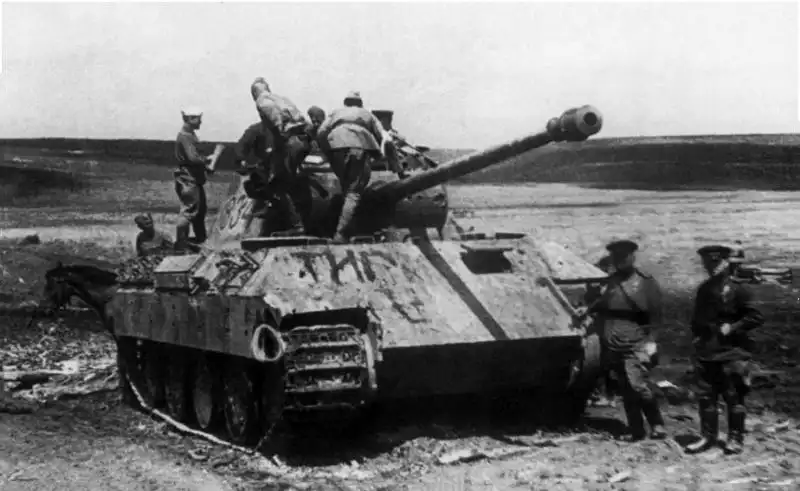
Red Army soldiers inspect one of the first destroyed German Panther tanks during the Battle of Kursk in the summer of 1943.
The summer of 1943 witnessed one of the most important armored battles in military history. During the Battle of Kursk, the German Army introduced several new armored vehicles that it hoped would restore the initiative on the Eastern Front. Among them was the formidable new Panzerkampfwagen V Panther, a tank that would become one of Germany's most famous armored fighting vehicles.
This photograph shows Soviet soldiers examining a knocked-out Pz.Kpfw. V Panther Ausf. D, tactical number 834, during the fighting around Kursk. The vehicle is believed to have been one of the first Panthers destroyed and inspected by Red Army troops after the type entered combat.
The Panther's Combat Debut:
The Panther was developed as Germany's answer to the Soviet T-34.
German designers sought to combine strong armor protection, excellent firepower, and high mobility into a single vehicle. The result was a tank armed with the powerful 75 mm KwK 42 L/70 gun and protected by heavily sloped frontal armor.
The first production Panthers of the Ausf. D series were rushed into service for Operation Citadel, the German offensive against the Kursk Salient.
New Panther units were assigned to:
- The 51st and 52nd Panzer Battalions
- The 23rd and 26th Panzer Regiments
- Elements of the Waffen-SS divisions Leibstandarte Adolf Hitler and Das Reich
German commanders expected the new tank to provide a decisive battlefield advantage.
Reality proved more complicated.
Technical Problems and Heavy Losses:
Although the Panther possessed impressive combat capabilities, its introduction was rushed.
Many vehicles suffered from mechanical failures even before reaching combat. Engine fires, transmission breakdowns, and suspension problems plagued the new tanks during the opening stages of the offensive.
As a result, a significant number of Panthers were lost to technical issues rather than enemy fire.
Others were destroyed by Soviet artillery, mines, anti-tank guns, and tank crews who quickly learned to exploit weaknesses in the new German vehicle.
The tank shown in this photograph became one of the first examples available for Soviet examination.
The Curious Inscription on the Front Armor:
One of the most interesting details visible in the photograph is a handwritten inscription painted on the front armor plate in Russian.
The exact meaning remains debated.
According to one interpretation, the inscription reads "TIR" ("Target" or "Firing Range"), indicating that the vehicle was destined for ballistic testing. Captured German tanks were frequently transported to Soviet proving grounds where engineers tested their resistance to various anti-tank weapons.
Another theory suggests that the inscription was the beginning of the word "Tiger" and was never completed.
If this explanation is correct, it may reveal a fascinating moment of battlefield confusion. Soviet troops encountering the new German tank for the first time may have initially mistaken it for another feared German vehicle—the Tiger.
Such confusion would be understandable. In the summer of 1943, many Red Army soldiers had never seen a Panther before.
Soviet Intelligence and Captured German Armor:
The capture of relatively intact German tanks was of enormous value to Soviet military specialists.
Engineers carefully studied armor thickness, manufacturing techniques, optics, weapons, engines, and mechanical systems.
The information gathered from captured Panthers contributed to a better understanding of German armored technology and helped Soviet designers evaluate the strengths and weaknesses of their opponent's newest vehicles.
The Soviet practice of transporting captured equipment to testing facilities became an important source of battlefield intelligence throughout the war.
The Battle of Kursk:
The Battle of Kursk remains the largest armored confrontation in history.
Beginning in July 1943, German forces attempted to eliminate the Kursk Salient through a massive pincer offensive. The operation involved thousands of tanks, assault guns, aircraft, and artillery pieces.
The failure of Operation Citadel marked a turning point on the Eastern Front.
After Kursk, Germany permanently lost the strategic initiative, while the Red Army increasingly seized the offensive and began the long advance toward Berlin.
The destroyed Panther seen in this photograph therefore represents more than a single battlefield loss—it symbolizes the failure of Germany's final major offensive in the East.
A New Threat, But Not a War-Winning Weapon:
The Panther would eventually earn a reputation as one of the best medium tanks of the Second World War.
Its powerful gun and excellent frontal armor made it a dangerous opponent for Allied tanks throughout the remainder of the conflict.
However, no weapon could reverse Germany's worsening strategic position.
Even as Panther production increased, the Soviet Union continued to outproduce Germany in tanks, artillery, aircraft, and ammunition.
The wrecked Panther in this image serves as a reminder that technological superiority alone could not determine the outcome of a global war.
Conclusion:
This remarkable photograph captures a historic moment on the Eastern Front.
A group of Soviet soldiers stands around one of the first destroyed Panther tanks encountered during the Battle of Kursk. Their curiosity reflects the significance of the vehicle before them—a brand-new German weapon intended to change the course of the war.
Instead, the knocked-out Panther became a battlefield trophy, an intelligence source, and a symbol of the increasingly difficult struggle facing the German Army in 1943.
Photo Details:
📍 Location: Kursk Region, USSR
📅 Date: Summer 1943
📷 Photographer: Unknown
Recommended Reading:
- The Battle of Kursk — David M. Glantz & Jonathan House
- Kursk 1943: The Greatest Battle — Roman Töppel
- Panther Tank: The Quest for Combat Supremacy — Thomas L. Jentz
- Panzer Tracts No. 5-1 Panther Ausf. D — Thomas L. Jentz & Hilary Doyle
- Russia's War — Richard Overy
- When Titans Clashed — David M. Glantz & Jonathan House