German Panzer III and Panzer II tanks knocked out during the Battle of Kursk. The photograph captures the fading generation of Wehrmacht armored vehicles.
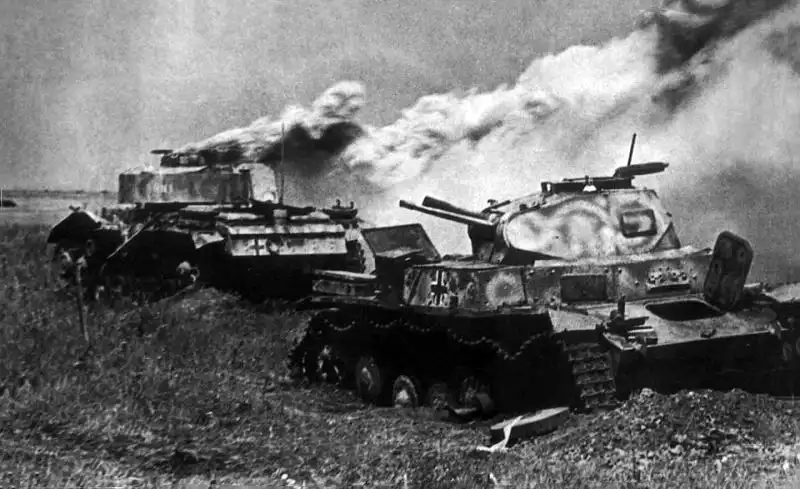
This remarkable photograph captures the immediate aftermath of a clash during the Battle of Kursk in the summer of 1943. In the foreground stand two German armored vehicles destroyed or disabled by Red Army forces: a burning Panzer III and a damaged Panzer II.
Smoke still rises from the Panzer III, indicating that the photograph was taken shortly after the fighting ended. The image freezes a brief moment between battle and recovery, when the battlefield still bore fresh traces of combat.
A Battlefield Still Smoldering:
Unlike many wartime photographs taken hours or days after a battle, this image appears to have been made almost immediately after the engagement.
The Panzer III continues to burn, sending a column of smoke into the sky. The fire may have resulted from an ammunition detonation, a fuel fire, or penetration by Soviet anti-tank weapons.
Nearby stands a Panzer II. Unlike its larger companion, the light tank shows no obvious signs of fire or catastrophic damage.
Its right track has been thrown off, leaving the vehicle immobilized.
The open hatches suggest that the crew abandoned the tank after losing mobility and retreated from the battlefield before Soviet troops reached the position.
The Panzer III: Former Backbone of the Wehrmacht:
When Germany invaded Poland in 1939 and France in 1940, the Panzer III represented the future of German armored warfare.
Designed specifically to fight enemy tanks, it became one of the most important vehicles of the Wehrmacht during the early years of the war.
The tank fought in:
- Poland
- France
- The Balkans
- North Africa
- The Soviet Union
For a time, it formed the core of Germany's armored divisions.
By 1943, however, the situation had changed dramatically.
The appearance of the Soviet T-34 and KV tanks exposed the limitations of the Panzer III design. Although upgraded several times, the vehicle was approaching the limits of its development potential.
At Kursk, many Panzer IIIs found themselves outmatched by newer Soviet armor and increasingly powerful anti-tank guns.
The Panzer II: An Obsolete Survivor:
The presence of a Panzer II on the battlefield is perhaps even more revealing.
Originally designed as a temporary training and reconnaissance tank, the Panzer II was already considered obsolete by the time Germany launched Operation Barbarossa in 1941.
Its thin armor and relatively weak armament made it unsuitable for frontline tank-versus-tank combat against modern opponents.
Yet Germany's expanding war effort forced the Wehrmacht to continue using older vehicles long after their intended service life.
By the summer of 1943, Panzer IIs were often employed in reconnaissance, security duties, communications, or support roles.
The disabled vehicle in this photograph illustrates how desperately Germany relied on every available armored vehicle during the later years of the war.
Kursk: The End of Germany's Strategic Initiative:
The Battle of Kursk marked a turning point not only in strategy but also in armored warfare.
The German Army entered the offensive with a mixture of old and new equipment. Alongside Panthers, Tigers, and Ferdinand tank destroyers served large numbers of older Panzer III and Panzer IV tanks.
This battlefield scene perfectly reflects that transition.
The Panzer II represented the legacy of Germany's early victories.
The Panzer III represented the main fighting force of the Wehrmacht's middle years.
The Panther and Tiger, appearing elsewhere on the battlefield, represented Germany's hopes for the future.
None of them would be enough.
Following the failure of Operation Citadel, the German Army permanently lost the strategic initiative on the Eastern Front.
Why the Open Hatches Matter:
One of the most interesting details in the photograph is the condition of the Panzer II.
The open hatches strongly suggest that at least some members of the crew survived.
Tank crews often abandoned immobilized vehicles when recovery became impossible or when remaining inside offered little chance of survival.
The loss of a track could transform a combat vehicle into a stationary target for artillery, anti-tank guns, or infantry armed with anti-tank weapons.
For many crews, escape was the only rational choice.
The photograph therefore tells two different stories at once: one tank destroyed in flames and another likely abandoned by soldiers who hoped to fight another day.
A Snapshot of Germany's Aging Armor:
Viewed today, the photograph is more than a record of two damaged vehicles.
It illustrates the changing nature of armored warfare in 1943. Vehicles that had once spearheaded Germany's victories across Europe were increasingly vulnerable on the battlefields of the Eastern Front.
The burning Panzer III and disabled Panzer II symbolize the gradual decline of the armored force that had conquered much of Europe only a few years earlier.
Conclusion:
This image captures a brief but powerful moment during the Battle of Kursk.
A burning Panzer III and an abandoned Panzer II stand side by side, silent witnesses to the enormous armored struggle unfolding across the Soviet countryside.
Photo Details:
📍 Location: Kursk Region, USSR
📅 Date: Summer 1943
📷 Photographer: Unknown
Recommended Reading:
- Kursk 1943: The Greatest Battle — Roman Töppel
- The Battle of Kursk — David M. Glantz & Jonathan House
- Panzer III at War — Michael Green
- Panzerkampfwagen III Medium Tank 1936–44 — Bryan Perrett
- Panzer II and Its Variants — Walter J. Spielberger
- When Titans Clashed — David M. Glantz & Jonathan House