A group of Soviet prisoners of war transported in a German heavy truck during the fighting in Ukraine in autumn 1941.
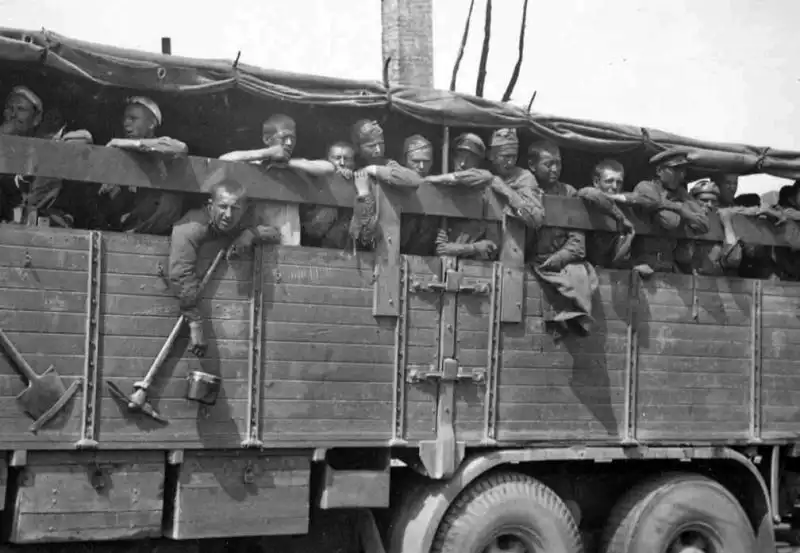
This photograph shows a large group of Soviet prisoners of war being transported in the cargo bed of a German heavy truck somewhere in Ukraine during the autumn of 1941.
Unlike many well-known images depicting endless columns of prisoners marching on foot, this photograph captures a less frequently seen aspect of captivity during the early months of the German invasion of the Soviet Union.
The truck itself appears to be either a Büssing-NAG Typ 900 heavy transport vehicle or possibly a Mercedes-Benz L 10000, both among the largest trucks used by Germany during the Second World War.
The Eastern Front in 1941:
The autumn of 1941 marked one of the most dramatic periods of the war.
German forces had advanced hundreds of kilometers into Soviet territory since the launch of Operation Barbarossa in June. Massive encirclement battles destroyed entire Soviet formations and resulted in enormous numbers of prisoners.
Ukraine became one of the principal theaters of these operations. Throughout the summer and autumn, Soviet armies fought desperate defensive battles while German armored spearheads continued their advance eastward.
Millions of Soviet soldiers would eventually fall into German captivity during the first phase of the campaign.
An Unusual View of Captivity:
Most surviving wartime photographs show prisoners marching under guard for long distances.
This image is different. Here, the prisoners are packed into the rear of a heavy transport vehicle, suggesting movement between collection points, temporary holding areas, railway stations, or prisoner camps.
The photograph offers a glimpse into the logistical challenges created by the enormous numbers of captured Soviet troops. German authorities often struggled to process, guard, and transport prisoners captured during large encirclement battles.
The Heavy Truck:
One of the most interesting details in the image is the vehicle itself.
The truck appears to belong to the class of heavy-duty transport vehicles used by the Wehrmacht to move personnel, supplies, ammunition, and military equipment over long distances.
The identification is not entirely certain, but the vehicle resembles either a Büssing-NAG Typ 900 or a Mercedes-Benz L 10000, both powerful heavy trucks capable of carrying substantial loads.
Such vehicles played an important role in maintaining German mobility during the first years of the war, particularly across the vast distances of the Soviet Union.
The Human Dimension:
Although military vehicles often attract attention, the most important element of the photograph remains the men riding in the cargo bed.
Only a few months earlier, these soldiers had been serving in active Red Army units. By the autumn of 1941, many Soviet formations had been shattered in some of the largest encirclement battles in military history.
The expressions and identities of the prisoners are lost to history, yet the photograph preserves a moment in their wartime experience—one shared by countless others during the first year of the conflict.
Ukraine During the Campaign:
The fighting in Ukraine produced some of the largest military disasters of the Second World War.
The battles around Uman, Kiev, and other major encirclements generated vast numbers of prisoners and transformed the region into one of the central battlegrounds of the Eastern Front.
Although the exact location of this image remains unknown, it reflects the broader realities of the campaign that unfolded across Ukraine in 1941.
A Historical Record:
Photographs such as this are valuable because they document both military equipment and human experience.
The truck represents the industrial and logistical side of modern warfare. The prisoners represent its human cost.
Together, they create a powerful snapshot of a conflict that would ultimately reshape the course of world history.
Photo data:
📍 Location: Ukraine, USSR
📅 Date: Autumn 1941
📷 Photographer: Unknown
Recommended Literature:
- David Glantz — Barbarossa: Hitler's Invasion of Russia 1941
- Evan Mawdsley — Thunder in the East
- Geoffrey Megargee — War of Annihilation
- Christian Hartmann — Operation Barbarossa
- John Erickson — The Road to Stalingrad
- Catherine Merridale — Ivan's War: Life and Death in the Red Army