French prisoners of war captured during the German campaign of 1940 stand under guard shortly after the collapse of French resistance.
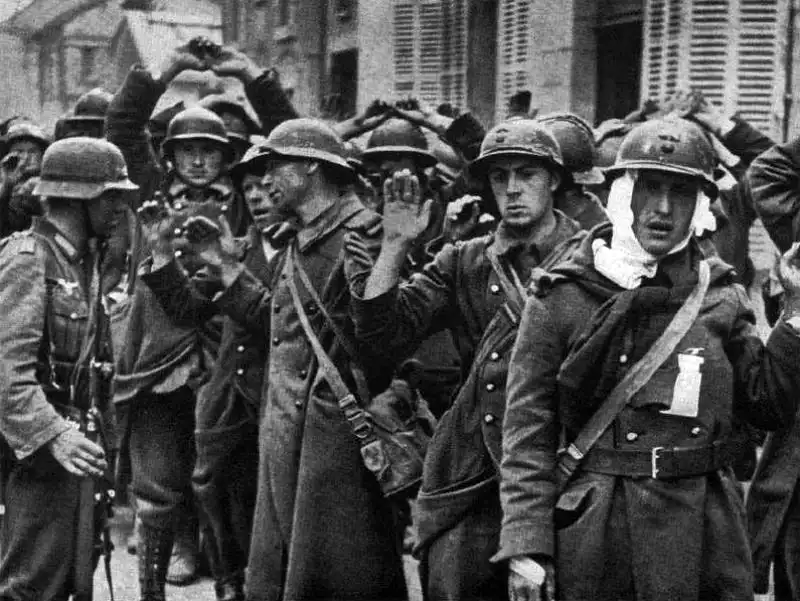
This striking photograph shows a large group of French prisoners of war captured during the German campaign in France in 1940. The prisoners stand with their hands raised while a Wehrmacht soldier armed with a Mauser carbine watches over them.
Several wounded French soldiers can be seen among the captives, a reminder that many entered captivity immediately after combat. The image captures a moment that was repeated countless times during the dramatic collapse of French military resistance in the spring and early summer of 1940.
The Fall of France:
The Battle of France remains one of the most significant military campaigns of the Second World War.
When Germany launched its offensive in May 1940, Allied planners expected a repeat of the trench warfare that had characterized much of the First World War. Instead, German armored formations and motorized units executed a rapid campaign that shattered front lines and isolated entire armies.
Within only a few weeks, the military situation of France deteriorated dramatically. Large numbers of soldiers found themselves cut off, surrounded, or forced to surrender.
The Human Cost of Defeat:
Military history often focuses on tanks, aircraft, and strategic decisions, but photographs such as this reveal the human consequences of battlefield defeat.
The French soldiers shown here were ordinary servicemen who only days or weeks earlier had been defending their country. Some bear visible signs of recent combat, while others appear exhausted after retreat, encirclement, or capture.
For many prisoners, captivity would last years. Hundreds of thousands of French servicemen remained in German prisoner-of-war camps until the final stages of the conflict.
The German Guard:
One detail that immediately draws attention is the appearance of the German sentry.
His face is dirty, his uniform shows signs of hard use, and he appears tired after prolonged field service. While Germany achieved a rapid victory in France, the campaign itself required intense combat operations, long marches, and continuous military effort from the units involved.
The photograph therefore reminds us that even victorious armies paid a price in fatigue, hardship, and battlefield losses.
A Moment During a Historic Campaign:
The image was likely taken during the final stages of the fighting, when large numbers of French troops were being disarmed and gathered under German control.
Scenes like this became increasingly common as organized resistance collapsed and German forces advanced deeper into the country. Entire formations surrendered, adding to the enormous number of prisoners captured during the campaign.
For contemporary observers, such scenes symbolized the stunning speed of Germany's victory.
Beyond the Battlefield:
The photograph also demonstrates how quickly the status of a soldier could change during wartime.
One day these men were combatants carrying rifles and serving in military units. Shortly afterward they found themselves disarmed prisoners under enemy guard.
This sudden transition from active soldier to captive was a reality experienced by millions during the Second World War.
Historical Significance:
Today, photographs of prisoners of war provide valuable evidence for historians.
They reveal details of uniforms, equipment, battlefield conditions, and the human experience of military defeat. More importantly, they preserve the faces of individuals whose lives were profoundly altered by events far larger than themselves.
This image remains a powerful reminder that behind every military campaign stand countless personal stories of hardship, survival, and uncertainty.
Photo data:
📍 Location: France
📅 Date: 1940
📷 Photographer: Unknown
Recommended Literature:
- Julian Jackson — The Fall of France: The Nazi Invasion of 1940
- Karl-Heinz Frieser — The Blitzkrieg Legend
- Alistair Horne — To Lose a Battle: France 1940
- Ernest R. May — Strange Victory
- Robert Forczyk — Case Red: The Collapse of France
- Martin Alexander — After Dunkirk: The French Army's Performance Against "Case Red"