A column of Soviet prisoners captured during the fighting in Ukraine in 1941. The photograph reflects the scale of the Red Army's losses during the first months of Operation Barbarossa.
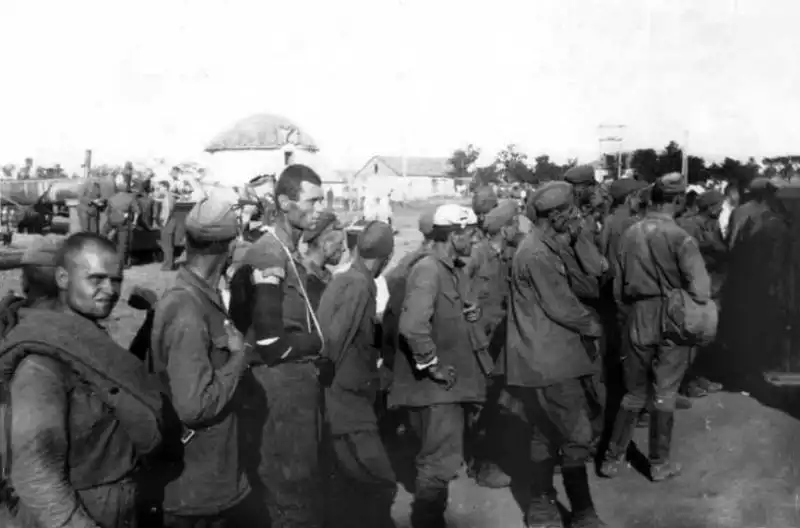
This photograph shows a large column of Soviet prisoners of war captured during the German advance across Ukraine in the autumn of 1941. Exhausted Red Army soldiers march under guard while German troops observe from the background.
Among the prisoners, two lightly wounded Soviet servicemen can be seen near the center of the image. Their presence serves as a reminder that many men entered captivity immediately after combat, often carrying untreated wounds and suffering from exhaustion.
The photograph captures one of the most tragic aspects of the war on the Eastern Front—the mass capture of Soviet soldiers during the opening months of Operation Barbarossa.
The Collapse of the Front in 1941:
When Germany invaded the Soviet Union on June 22, 1941, the Red Army faced an enemy that had already perfected the art of rapid mobile warfare.
German armored formations broke through defensive lines, encircled entire armies, and advanced hundreds of kilometers into Soviet territory. In many sectors, Soviet units found themselves cut off from supplies, communications, and reinforcements.
Large encirclement battles became a defining feature of the campaign. Entire formations were surrounded and destroyed, producing enormous numbers of prisoners.
The Battle for Ukraine:
Ukraine became one of the main objectives of the German offensive.
Its agricultural resources, industrial centers, and strategic location made it a key target for the Wehrmacht. Throughout the summer and autumn of 1941, massive battles were fought across the region.
Some of the largest encirclements in military history occurred here. Hundreds of thousands of Soviet soldiers were trapped in pockets and forced either to surrender, attempt a breakout, or perish in combat.
Although the exact location of this photograph is unknown, it may have been taken during one of these major encirclement operations.
The Fate of Soviet Prisoners:
For many of the men seen in this image, captivity marked the beginning of an ordeal that would prove as dangerous as the battlefield itself.
The German military entered the campaign against the Soviet Union with little preparation for handling such vast numbers of prisoners. Combined with ideological hostility toward the Soviet state, this resulted in catastrophic conditions within many prisoner camps.
During the first years of the war, millions of Soviet prisoners suffered from hunger, disease, exposure, and neglect. Mortality rates among Soviet POWs were among the highest experienced by any major combatant nation during the Second World War.
A Human Perspective:
Despite the scale of the conflict, the photograph remains deeply personal.
The prisoners are not shown fighting or posing for propaganda purposes. They simply walk forward along a road, uncertain of what awaits them.
Some appear exhausted. Others still carry themselves with military bearing. The wounded men visible near the center remind us that each figure in the column had recently been part of the desperate fighting that engulfed the Soviet frontier regions.
A Symbol of 1941:
Many photographs symbolize particular phases of the war.
Burning tanks often represent the opening battles of Operation Barbarossa. Snow-covered soldiers evoke the struggle before Moscow. Likewise, long columns of prisoners became one of the defining images of the summer and autumn of 1941.
The photograph illustrates the scale of the Soviet military disaster during the first months of the German invasion, while also reminding us of the resilience that would later allow the Soviet Union to recover and continue the fight.
Historical Significance:
Today, images like this are important historical records.
They document not only military operations but also the human consequences of strategic decisions, battlefield defeats, and the immense pressures placed upon ordinary soldiers.
The men seen marching in this column represent thousands of similar stories from one of the most destructive campaigns in world history.
Photo data:
📍 Location: Ukraine, USSR
📅 Date: Autumn 1941
📷 Photographer: Unknown
Recommended Literature:
- David Glantz — Barbarossa: Hitler's Invasion of Russia 1941
- Evan Mawdsley — Thunder in the East
- John Erickson — The Road to Stalingrad
- Christian Hartmann — Operation Barbarossa
- Geoffrey Megargee — War of Annihilation
- Catherine Merridale — Ivan's War: Life and Death in the Red Army