Soviet pilot Major Ivan S. Polbin poses with his SB bomber on 17 August 1941, showing one of the most famous bomber commanders of the Red Army Air Force.
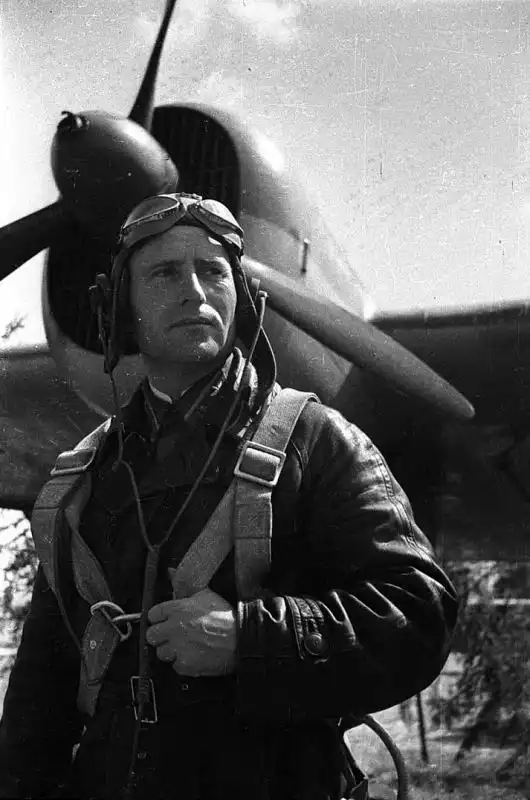
Soviet Pilot Major Ivan Polbin with His SB Bomber (17 August 1941):
This wartime photograph shows Major Ivan Semyonovich Polbin, a Soviet bomber pilot, posing against the background of his SB-2M-100A bomber on 17 August 1941 in the USSR. The image was taken at a critical moment, when the Red Army Air Force was fighting under extreme pressure during the first months of the German invasion.
Polbin was already a highly experienced and respected aviator, and this photograph captures him at a time when the fate of the country depended on the endurance and skill of frontline pilots.
Photo Information:
-
Location: USSR
-
Date: 17 August 1941
-
Photographer: Mikhail Savin
Who Was Ivan Semyonovich Polbin:
Ivan Semyonovich Polbin was one of the most famous Soviet bomber pilots and later commanders of the Great Patriotic War. He served in the Red Army from 1927 and had already proven himself before the war.
Key Points of His Career:
-
Twice Hero of the Soviet Union
-
Awarded the Order of Lenin for combat actions near the Khalkhin Gol River in 1939
-
In active combat service from July 1941 during the Great Patriotic War
-
Completed 157 combat sorties
-
Fought on the Western, Stalingrad, Bryansk, Voronezh, 1st and 2nd Ukrainian Fronts
-
Commanded:
-
The 150th High-Speed Bomber Aviation Regiment
-
The 301st Bomber Aviation Division (from 1942)
-
Later the 1st (2nd Guards, 6th Guards) Aviation Corps (from 1943)
-
Polbin was not only a combat pilot, but also a talented organizer and tactician who influenced the development of Soviet bomber tactics.
The SB Bomber in 1941:
The SB (Skorostnoi Bombardirovshchik) was a high-speed bomber designed in the 1930s and widely used at the beginning of the war.
Main Characteristics:
-
Twin-engine bomber
-
Designed for speed and medium-altitude bombing
-
By 1941, already becoming outdated against modern fighters
-
Still widely used due to the urgent need for every available aircraft
In the summer of 1941, crews flying the SB often faced:
-
Strong enemy fighter opposition
-
Heavy losses
-
The need to operate in difficult and rapidly changing conditions
Despite these challenges, aircraft like the SB continued to play an important role in the early defensive battles.
“The Carousel” Dive-Bombing Tactic:
One of Polbin’s most important contributions was the development and introduction of a group dive-bombing attack pattern, often called the “carousel”. This method allowed bomber groups to:
-
Attack targets in a continuous sequence
-
Maintain pressure on enemy positions
-
Improve bombing accuracy
-
Reduce exposure time over heavily defended targets
This tactical innovation significantly increased the combat effectiveness of Soviet bomber units and was widely adopted in later operations.
From Frontline Pilot to Air Corps Commander:
As the war progressed, Polbin’s role expanded from frontline pilot to high-level commander. He combined:
-
Personal combat experience
-
Tactical creativity
-
Organizational skill
This made him one of the key figures in the development of Soviet bomber aviation during the war.
By 1943, he was already commanding large aviation formations, shaping air operations on a strategic scale.
His Final Mission:
Guards Major General of Aviation Ivan Polbin was killed in action on 11 February 1945 near Breslau, during his 157th and final combat sortie. He died as he had lived during the war — in the air, on a combat mission.
His death came just months before victory, but his contribution to Soviet aviation and to the outcome of the war was already immense.
Why This Photograph Matters:
This image is significant because it shows:
-
A legendary Soviet pilot at the beginning of the war
-
The type of aircraft used in the hardest early period
-
The human face behind later high command and decorations
-
A moment of calm before years of intense combat and command responsibility
It connects the early, desperate phase of the war with the later large-scale air operations that Polbin helped to shape.
Conclusion:
The photograph of Major Ivan Semyonovich Polbin with his SB bomber on 17 August 1941 captures a key figure of Soviet military aviation at a critical moment in history. A brilliant pilot, innovator, and commander, Polbin left a deep mark on the development of bomber tactics and on the course of the air war. His life and service remain a powerful example of skill, courage, and dedication in one of the most demanding chapters of the 20th century.