Navigator Senior Lieutenant Osipov from Ivan Polbin’s crew poses by the SB bomber turret on 17 August 1941, during the hardest early months of the war.
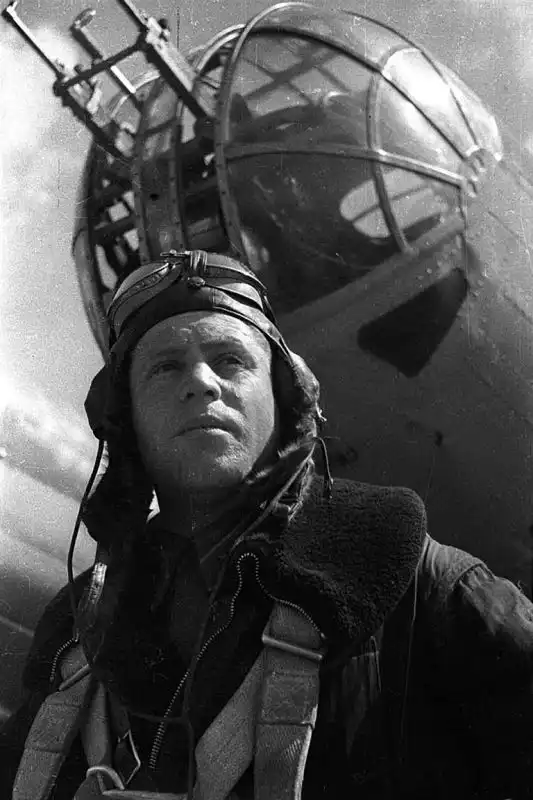
Navigator Osipov from Ivan Polbin’s Crew (17 August 1941):
This wartime photograph shows Senior Lieutenant Osipov, the navigator of Ivan Semyonovich Polbin’s crew, posing beside the machine-gun turret of an SB bomber on 17 August 1941 in the USSR. The image was taken by a well-known Soviet photographer during one of the hardest periods of the war — the early phase of the German blitzkrieg in the East, when the Red Army was forced into difficult and costly retreats.
The photograph was intended not only as documentation, but also as morale-boosting imagery, showing confident airmen continuing their mission despite the pressure of the enemy advance.
Photo Information:
-
Location: USSR
-
Date: 17 August 1941
-
Photographer: Mikhail Savin
What the Photo Shows:
The image focuses on Navigator Osipov standing near the defensive turret of the SB bomber. The composition emphasizes:
-
The crew’s role inside the aircraft
-
The defensive armament used to protect bombers from fighters
-
The calm, composed posture of an airman during a critical phase of the war
Rather than a dynamic combat scene, this is a human portrait of a combat professional — someone whose daily work combined navigation, target approach, and survival in hostile airspace.
The Role of a Navigator in Bomber Crews:
In Soviet bomber aviation, the navigator was a key member of the crew. His responsibilities included:
-
Route planning and in-flight navigation
-
Target identification and approach calculations
-
Bombing accuracy and timing
-
Assisting in situational awareness during missions
In the early months of the war, when navigation aids were limited and missions were flown under intense enemy pressure, the navigator’s skill could decide whether a crew reached its target and returned home.
The SB Bomber and Its Defense:
The SB (Skorostnoi Bombardirovshchik) was a fast bomber of prewar design that was still widely used in 1941. By that time, it faced:
-
Strong enemy fighter opposition
-
Heavy losses
-
The need to rely on defensive machine-gun turrets and tight formations
The turret visible in the photo symbolizes the constant threat from enemy fighters and the importance of every crew member’s role in survival.
August 1941: The Hardest Weeks:
By August 1941, the Red Army Air Force was operating under extreme strain:
-
Rapid retreats and changing front lines
-
Shortages of modern aircraft
-
High operational tempo and heavy losses
-
Continuous pressure from enemy air superiority
Photographs like this were used to support morale, showing that aircrews remained disciplined, confident, and ready to fight despite the situation on the ground.
Ivan Polbin’s Crew:
Serving under Ivan Semyonovich Polbin, who would later become one of the most famous Soviet bomber commanders, meant:
-
High operational demands
-
Intensive combat missions
-
Emphasis on discipline, coordination, and tactical innovation
Navigator Osipov was part of a team that would contribute to the development and execution of more effective bomber tactics as the war progressed.
Why This Photograph Matters:
This image is important because it shows:
-
The human side of bomber aviation in 1941
-
A key crew role often overshadowed by pilots
-
The atmosphere of determination during a period of retreat
-
How photography was used to support morale and confidence
It reminds us that air warfare depended not only on machines, but on trained specialists working together under constant risk.
Conclusion:
The photograph of Senior Lieutenant Osipov, navigator from Ivan Polbin’s crew, on 17 August 1941 captures a moment of quiet resolve during one of the most difficult phases of the war. Standing by the turret of the SB bomber, he represents the countless airmen who continued to fly, navigate, and fight — even when the situation seemed darkest — and whose professionalism helped lay the groundwork for later victories.