Wedding rings taken from victims of Nazi camps and discovered by U.S. soldiers in Buchenwald on 5 May 1945, documenting the material evidence of mass murder.
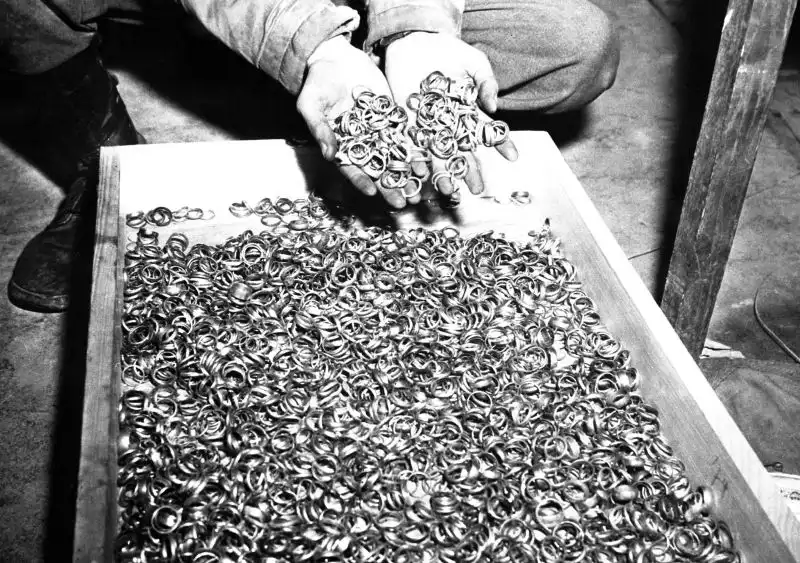
“Gold of the Third Reich” Found in Buchenwald (5 May 1945):
This harrowing photograph shows what was cynically called the “Gold of the Third Reich” — wedding rings taken by the Nazis from their victims in a concentration camp and discovered by American soldiers in Buchenwald on 5 May 1945.
These rings were not treasure in any normal sense. They were personal belongings stripped from murdered people, collected, stored, and treated as material value by a regime built on systematic mass murder.
Photo Information:
-
Location: Buchenwald, Germany
-
Date: 5 May 1945
What the Photo Shows:
The image documents a collection of wedding rings recovered by U.S. troops after the liberation of the camp. Each ring once belonged to a person who had:
-
Been deported
-
Stripped of all personal possessions
-
Reduced to a number
-
And, in many cases, murdered
What appears as a pile of metal objects is, in reality, evidence of countless destroyed lives and families.
Why These Rings Were Collected:
In the Nazi camp system, victims were systematically robbed:
-
Jewelry, watches, and valuables were confiscated
-
Gold teeth and personal items were removed
-
Clothing and possessions were sorted and reused or sent to storage
-
Even the smallest personal items were treated as “resources”
Wedding rings were especially symbolic — they represented identity, family, and personal history, all of which the camp system aimed to erase.
Buchenwald in 1945:
By the spring of 1945, Buchenwald had become a place of:
-
Extreme overcrowding
-
Starvation and disease
-
Systematic brutality
-
Mass death
When American forces arrived, they found not only survivors, but also material proof of industrial-scale crimes: records, warehouses of stolen goods, and objects like these rings — silent witnesses to what had happened.
The Meaning of the Discovery:
For the soldiers who found these items, the discovery was:
-
Shocking
-
Overwhelming
-
Impossible to dismiss as propaganda or rumor
Objects like these rings provided undeniable physical evidence of the crimes committed. They showed that murder was not only ideological, but also organized, bureaucratic, and exploitative down to the smallest detail.
From Personal Objects to Historical Evidence:
Today, such photographs serve several purposes:
-
As proof of crimes against civilians and prisoners
-
As memorials to the victims who left no other trace
-
As historical documents used in investigations and trials
-
As a warning about what happens when a state turns murder into policy
Each ring in the photograph represents a life, a family, and a story that was violently cut short.
Historical Significance of the Image:
This image is important because it shows:
-
The material aftermath of mass murder
-
How victims were reduced to sources of profit and resources
-
The scale and organization of the crimes
-
The moment when these crimes were exposed to the outside world
It connects abstract numbers of victims to real, tangible human traces.
Conclusion:
The photograph of the wedding rings found in Buchenwald on 5 May 1945 is one of the most powerful and disturbing records of the end of the war in Europe. These objects, once symbols of love and family, became evidence of systematic murder and theft.
Calling this collection the “Gold of the Third Reich” reveals the moral abyss of the system that created it — and reminds us that behind every ring was a person whose life was taken and whose memory must not be erased.