Red Army artillery crew with a 45 mm anti-tank gun during the fighting in Belarus in June 1944 as part of Operation Bagration.
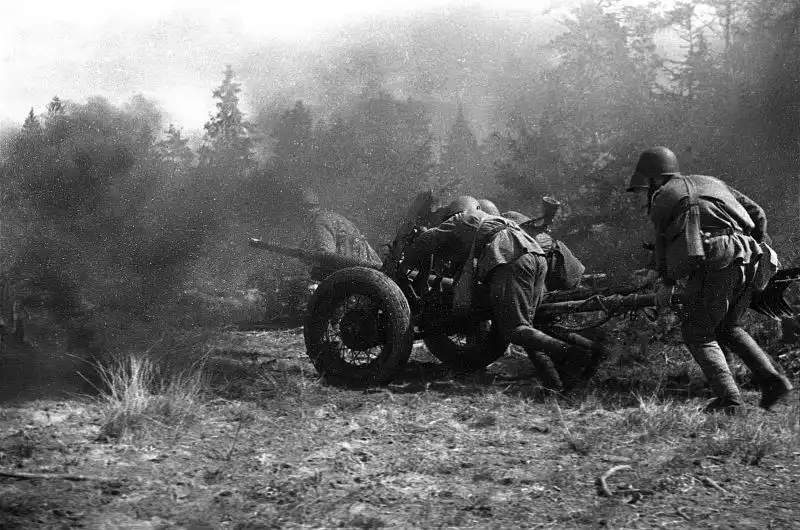
Red Army 45 mm Anti-Tank Gun Crew in Belarus (June 1944):
This wartime photograph shows a Red Army artillery crew operating a 45 mm anti-tank gun model 1934 during the fighting in Belarus in June 1944, as part of Operation Bagration. The gun is identifiable by its distinctive spoked “Ford-style” wheels, a feature typical of early Soviet artillery designs.
The image captures a moment from one of the most successful and decisive Soviet offensives of the war.
Photo Information:
-
Location: Belarus, USSR
-
Date: June 1944
-
Photographer: Mikhail Savin
What the Photo Shows:
The photograph depicts:
-
A 45 mm anti-tank gun positioned for action
-
Its crew from the Red Army artillery
-
A frontline environment during an active offensive
This is not a ceremonial or rear-area scene. The gun and its crew are clearly in a combat zone, where speed of deployment and coordination with infantry were critical.
The 45 mm Anti-Tank Gun Model 1934:
The 45 mm gun model 1934 was one of the standard light anti-tank weapons of the Red Army in the early and mid-war period.
Key Features:
-
Relatively light and mobile
-
Could be moved by its crew over short distances
-
Effective against light and medium armored vehicles at close to medium ranges
-
Simple and robust design
The spoked wheels, sometimes called “Ford-style,” reflect the influence of earlier automotive and artillery designs and make this version easy to recognize in photographs.
Operation Bagration and the Fighting in Belarus:
In June 1944, the Red Army launched Operation Bagration, a massive strategic offensive aimed at destroying German Army Group Centre.
The operation resulted in:
-
The liberation of large parts of Belarus
-
The destruction or encirclement of numerous German units
-
A dramatic collapse of German defenses in the region
-
A major shift in the strategic situation on the Eastern Front
Artillery units like the one shown in this photo played a vital role by:
-
Supporting infantry advances
-
Destroying enemy strongpoints
-
Engaging German armored counterattacks
-
Securing breakthroughs during fast-moving operations
The Role of Gun Crews in Offensive Operations:
Anti-tank gun crews worked under extremely dangerous conditions:
-
They had to deploy in exposed positions
-
Enemy tanks and infantry actively hunted gun positions
-
Casualties were often high
-
Success depended on discipline, teamwork, and precise timing
Despite these risks, such crews were essential for holding newly captured ground and protecting advancing troops from counterattacks.
Why This Photograph Matters:
This image is significant because it shows:
-
A typical Red Army anti-tank gun and crew in 1944
-
The practical reality of combined-arms warfare during a major offensive
-
The human element behind artillery statistics and battle reports
-
A moment from one of the most decisive operations of World War II
It reminds us that large strategic victories were built from countless small-unit actions like this one.
Historical Significance of the Image:
The photograph documents:
-
The technical equipment of Soviet artillery units
-
The conditions under which they fought in Belarus
-
The intensity of the 1944 summer offensive
-
The crucial role of artillery in Red Army successes
It provides a direct visual connection to Operation Bagration, one of the turning points of the war in Eastern Europe.
Conclusion:
The image of a Red Army 45 mm anti-tank gun crew in Belarus in June 1944 captures the everyday reality of a great offensive. With their light but deadly gun, these artillerymen formed a key part of the force that shattered German defenses during Operation Bagration and helped carry the war westward toward its final stages.