Historic photograph from June 23, 1941, capturing a Soviet BT-7 light tank from the 5th Tank Division crushed against a German 7th Panzer Division staff car during early Operation Barbarossa.
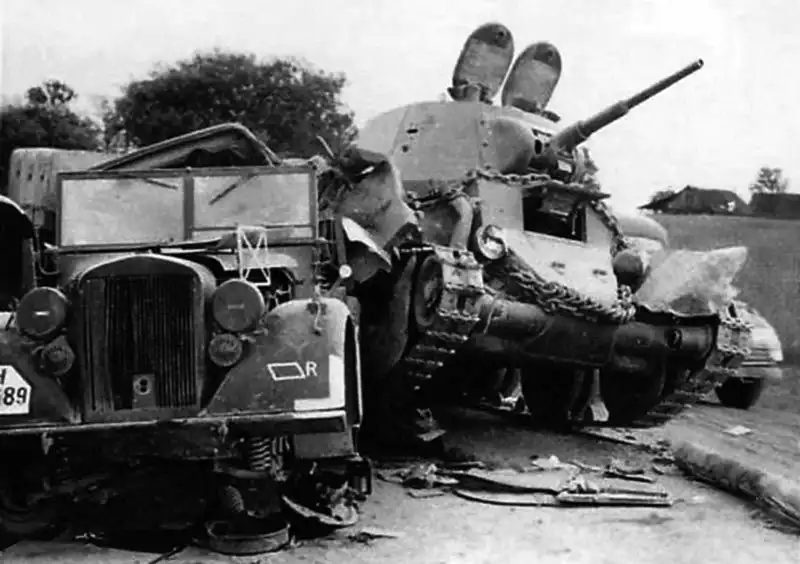
Soviet BT-7 Light Tank Ramming a German Staff Car in Lithuania (June 23, 1941)
This dramatic photograph captured on June 23, 1941—the second day of the outbreak of Operation Barbarossa—depicts a violent collision between a Soviet BT-7 light tank and a German Wehrmacht staff car during early meeting engagements in Lithuania.
Historical unit markings visible on both vehicles allow for precise identification: the BT-7 belonged to the Red Army's 5th Tank Division (3rd Mechanized Corps, 11th Army), which engaged units of the German 7th Panzer Division near Alytus in one of the opening armored battles on the Eastern Front.
Equipment, Uniforms, and Visual Features
The image offers extraordinary visual documentation regarding tactical unit markings and vehicle combat damage during the summer of 1941:
- Wehrmacht Staff Car Tactical Insignia: The front fender of the German passenger vehicle (likely a Horch 901 or Wanderer field car) clearly displays the tactical insignia of the 7th Panzer Division alongside the letter "R" and regimental staff symbols, tying the vehicle directly to the headquarters element of Panzer-Regiment 25.
- BT-7 Tank Identification: The BT-7 features a conical turret (1937–1938 production model) painted with a white tactical cross identification scheme utilized by the 5th Tank Division during the initial defense of the Baltic military district.
- Impact and Collision Details: The BT-7 tank drove its right track directly over the front hood and engine bay of the staff car, crushing the fender and chassis. Heavy towing chains remain wrapped across the tank's glacis plate.
- Open Turret Hatches: Both circular turret hatches (often referred to as "rabbit ears") are fully locked open, indicating the Soviet tank crew either surveyed the immediate chaotic battlefield from open positions or evacuated the vehicle following the collision.
The Battle of Alytus and Early Armored Clashes in 1941
On June 22–23, 1941, the Soviet 5th Tank Division mounted a fierce resistance at the Neman River bridges near Alytus against the advancing 7th Panzer Division. Despite severe ammunition shortages and overwhelming enemy air superiority, Soviet tank crews conducted aggressive counterattacks and tactical rammings against German motorized columns before retreating eastward.
📍 Location: Alytus area, Lithuania, USSR
📅 Date: June 23, 1941
📷 Photographer: Unknown
📰 Primary Source: Historical Eastern Front armored combat archive
Recommended reading:
- Early Barbarossa tank battles: The engagement of the 5th Tank Division at Alytus in June 1941
- Soviet light armor: Technical evolution and combat deployment of the BT-7 fast tank
- Wehrmacht tactical symbols: Deciphering divisional and regimental staff markings on German field vehicles
- Tactical combat methods: Documented instances of tank ramming tactics on the Eastern Front in 1941