Rare October 1941 action photograph showing a German Heinkel He 111 medium bomber dropping an aerial torpedo at low altitude against Allied shipping in the Atlantic.
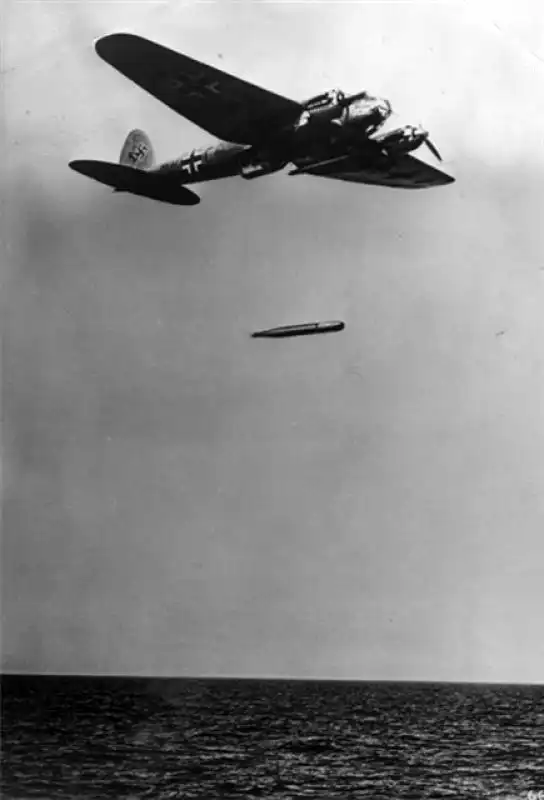
Heinkel He 111 Torpedo Bomber Executing a Low-Level Attack on an Atlantic Convoy (October 1941)
This striking action photograph from October 1941 captures the exact instant a German Luftwaffe Heinkel He 111 German medium bombers on the Eastern Front releases an aerial torpedo during a low-altitude attack against Allied convoy shipping in the Atlantic Ocean.
Contrary to the misconception that the aging He 111 design was phased out of specialized maritime strike roles by late 1941, the introduction of dedicated torpedo-carrying variants—most notably the He 111 H-6—marked the beginning of the aircraft's most devastating anti-shipping campaigns of World War II.
Equipment, Uniforms, and Visual Features
The image highlights critical technical elements of Luftwaffe maritime aviation tactics during the mid-war period:
- Mid-Air Torpedo Release: The photograph clearly depicts an airborne 450 mm naval torpedo (likely an LT F5b) falling toward the ocean surface seconds after detachment from the underside rack.
- Low-Altitude Attack Profile: To ensure proper entry angles and prevent torpedo gyro mechanism failure upon water impact, pilots executed release runs at extremely low altitudes, typically between 10 and 30 meters above sea level, under heavy anti-aircraft fire from escort vessels.
- Dedicated Torpedo Racks: The aircraft is fitted with external heavy-duty PVC ordnance racks beneath the central fuselage, capable of carrying two full-sized naval torpedoes or heavy magnetic sea mines.
- Distinctive Aircraft Silhouette: The elliptical wings and characteristic glass nose enclosure of the He 111 are clearly visible against the sky as the bomber maintains its egress vector over open sea waves.
The Legacy of Luftwaffe Torpedo Squadrons in 1941–1943
Beginning in late 1941, specialized units such as Kampfgeschwader 26 "Löwen" deployed He 111 torpedo bombers extensively across the Atlantic, Mediterranean, and Arctic theaters. Using coordinated multi-vector attack tactics (known as the Goldene Zange or "Golden Pincers"), He 111 torpedo strikes inflicted severe losses on Allied maritime supply lines, playing a central role in the devastating destruction of Arctic Convoy PQ-17 in July 1942.
📍 Location: Atlantic Ocean
📅 Date: October 1941
📷 Photographer: Unknown
📰 Primary Source: Historical naval aviation archive
Recommended reading:
- Maritime aviation development: Design features and external racks of the He 111 H-6 torpedo bomber
- Luftwaffe naval tactics: The evolution of low-level aerial torpedo strikes in 1941–1942
- Arctic convoy battles: The role of KG 26 torpedo bombers in the destruction of Convoy PQ-17
- Naval ordnance history: Technical characteristics of German LT F5b aerial torpedoes