Action-packed April 1945 photograph showing a Red Army artillery crew towing a 76.2mm ZiS-3 divisional gun with an American-supplied Dodge WC-51 truck near Wriezen during the Berlin Offensive.
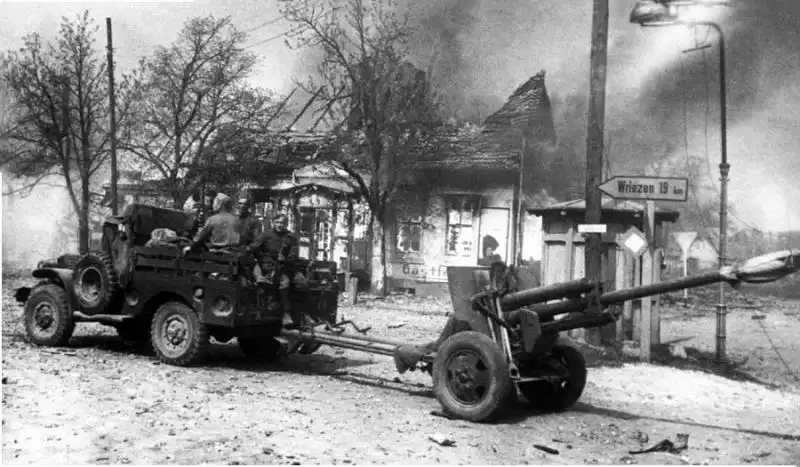
Soviet Artillery Crew on a Lend-Lease Dodge WC-51 near Wriezen (April 1945)
This dynamic April 1945 frontline photograph depicts a Red Army artillery crew towing a 76.2mm ZiS-3 divisional field gun using an American-supplied Dodge WC-51 3/4-ton 4x4 utility truck during the high-speed advance toward Berlin.
The scene unfolds in eastern Germany along the approach routes to the Seelow Heights and the Oder River, as evidenced by the German road sign in the background reading "Wriezen 19 km". In the background, a ruined roadside inn (Gasthof) burns following heavy combat operations in the sector.
Motorization and Equipment in the Berlin Offensive
The image illustrates the critical combination of Soviet artillery firepower and American transport mobility during the final strategic offensives of World War II:
- The Dodge WC-51 ("Dodge Three-Quarters"): Provided to the Soviet Union via Lend-Lease, the Dodge WC-51 was prized by Red Army personnel for its high cross-country capability, sturdy 4x4 drive system, and reliable engine, making it an ideal light prime mover for anti-tank and divisional artillery regiments.
- 76.2mm Divisional Gun ZiS-3: Designed by Vasily Grabin, the ZiS-3 was the most mass-produced Soviet artillery piece of WWII. Renowned for its reliability, low silhouette, and dual capabilities as both direct-fire anti-tank weapon and indirect field artillery, it served as the backbone of Soviet infantry division fire support.
- The Advance on Wriezen: Located east of Berlin near the Oder River, Wriezen was a key defensive stronghold held by German forces defending the approaches to the Reich capital. Forces of the 1st Belorussian Front bypassed and reduced these strongpoints during mid-April 1945.
- Crew Setup: The artillery crew and their equipment are packed into the open cargo bed of the Dodge WC-51, allowing rapid deployment into firing positions directly from the march.
The Impact of Allied Lend-Lease Logistics
By early 1945, the motorization provided by over 400,000 American trucks and utility vehicles allowed Red Army artillery, supply, and infantry units to maintain relentless operational momentum, preventing German forces from establishing stable defensive lines.
📍 Location: Near Wriezen, Brandenburg, Germany
📅 Date: April 1945
📷 Photographer: Unknown (Red Army Frontline Press Archive)
📰 Primary Source: Russian State Film and Photo Archive (RGAKFD) / Central Archive of the Russian Ministry of Defence (CAMD)
Recommended reading:
- Lend-Lease transport: The deployment and impact of Dodge WC series trucks in the Red Army
- Artillery history: Design, production, and combat application of the 76.2mm ZiS-3 gun
- The final offensive: Tactical operations of the 1st Belorussian Front in the Seelow-Wriezen sector
- Motorized logistics: How American trucks powered the Soviet advance on Berlin in 1945