U.S. Army 37mm GMC M6 tank destroyer on a Dodge WC-51 during training maneuvers in Tennessee, June 1943.
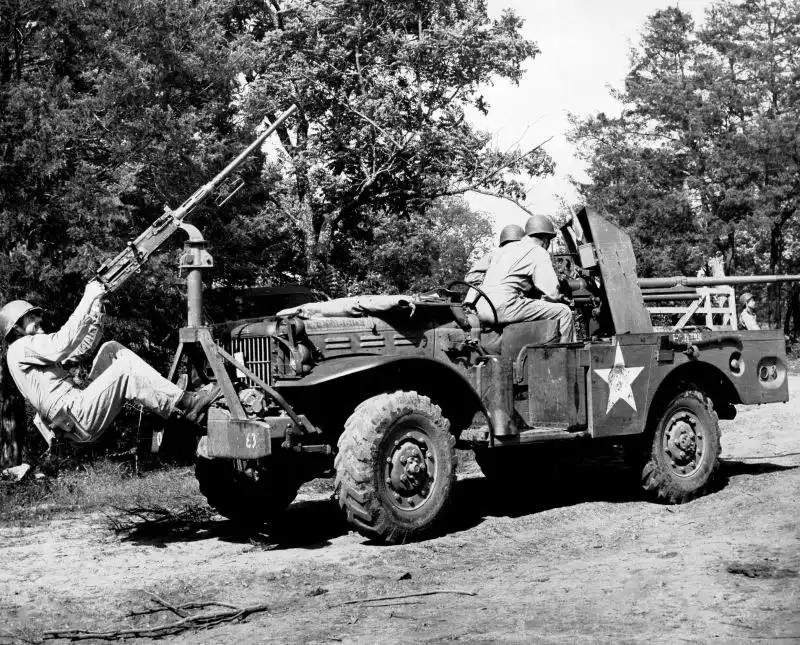
This wartime photograph shows a 37mm Gun Motor Carriage M6 (GMC M6) during U.S. Army training maneuvers near Watertown, Tennessee, on 6 June 1943. Built by mounting a 37 mm anti-tank gun on a Dodge WC-51 weapons carrier, the M6 became the first standardized tank destroyer fielded by the U.S. Army during World War II.
The First American Tank Destroyer
Following the early campaigns of the war, U.S. military planners recognized the need for highly mobile anti-tank weapons capable of responding quickly to enemy armored breakthroughs. Rather than waiting for purpose-built vehicles, they adopted a simple solution by installing the existing 37 mm M3 anti-tank gun onto the reliable Dodge WC-51 chassis.
The result was the 37mm GMC M6—an inexpensive and rapidly produced vehicle that combined road mobility with anti-tank capability.
Design and Characteristics
The M6 retained most of the standard Dodge WC-51 truck while replacing the cargo bed with a pedestal-mounted anti-tank gun.
Its main features included:
- 37 mm M3 anti-tank gun.
- Dodge WC-51 4×4 chassis.
- Open fighting compartment.
- High road speed and good mechanical reliability.
- .50 caliber Browning M2 machine gun for local defense.
The open design provided excellent visibility and rapid deployment but left the crew vulnerable to artillery fragments, machine-gun fire, and harsh weather.
The Nickname "Fargo"
American soldiers often referred to the vehicle as the "Fargo", a nickname derived from the Fargo Division of Chrysler, which participated in manufacturing Dodge military trucks. Although unofficial, the name appeared frequently in wartime references.
Approximately 5,400 M6 vehicles were produced between April and October 1942 to meet the rapidly expanding needs of the U.S. Army.
Combat Effectiveness
When the M6 entered service, the 37 mm gun was considered adequate against many early-war armored vehicles. However, battlefield experience soon demonstrated its limitations against newer German tanks with thicker armor.
By 1943, the vehicle was already becoming obsolete as a dedicated tank destroyer. More powerful designs such as the M10 Gun Motor Carriage gradually replaced it in frontline anti-tank units.
Even so, the M6 remained useful for training, reconnaissance support, convoy security, and operations where mobility was more important than heavy firepower.
What the Photograph Shows
This image documents:
- A 37mm GMC M6 mounted on a Dodge WC-51.
- U.S. Army training maneuvers in Tennessee.
- An early American approach to mobile anti-tank warfare.
- A vehicle designed before heavier German armor became common.
Rather than depicting combat, the photograph captures a stage in the evolution of American armored doctrine during World War II.
Historical Significance
The M6 occupies an important place in the history of U.S. armored forces. Although quickly surpassed by more capable tank destroyers, it represented the Army's first standardized attempt to create a fast, self-propelled anti-tank weapon.
The experience gained with vehicles such as the M6 helped shape later American tank destroyer doctrine and influenced the development of more effective self-propelled anti-tank systems.
Photo Information
- Vehicle: 37mm Gun Motor Carriage M6.
- Chassis: Dodge WC-51.
- Author: J. F. Albert.
- Location: Watertown, Tennessee, USA.
- Date: 6 June 1943.
Recommended Literature
- Steven J. Zaloga — US Tank Destroyers in Combat 1941–45.
- R. P. Hunnicutt — Half-Track: A History of American Semi-Tracked Vehicles.
- David Doyle — U.S. Tank Destroyers in Combat 1941–45.
- TM 9-2800 — Standard Military Motor Vehicles.
The 37mm GMC M6 marked the beginning of the U.S. Army's tank destroyer program. Although soon overshadowed by more heavily armed successors, it demonstrated how readily available commercial vehicles could be adapted into mobile anti-tank weapons during the early years of World War II, bridging the gap until more advanced designs entered service.