A Junkers Ju 88 bomber of KG 1 photographed on a snow-covered airfield on the Eastern Front in 1941.
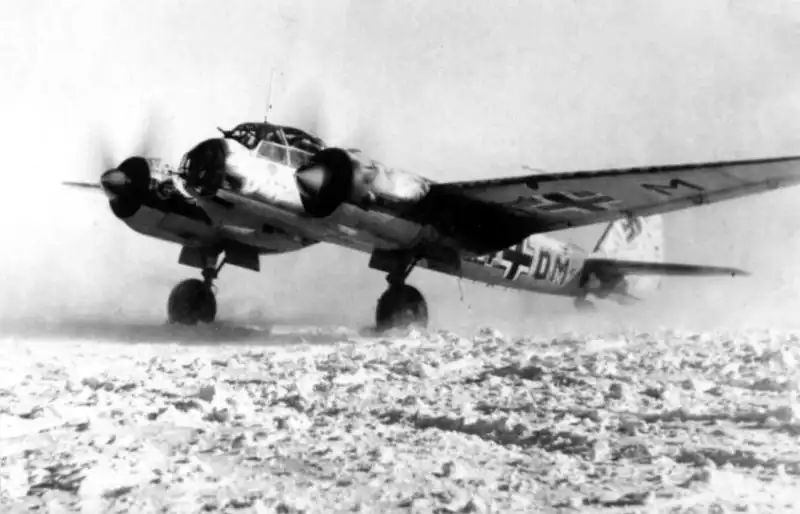
This wartime photograph shows a Junkers Ju 88 medium bomber of 4./Kampfgeschwader 1 (KG 1) parked on a snow-covered forward airfield on the Eastern Front during the winter of 1941. The image illustrates not combat itself but the demanding operational environment faced by Luftwaffe bomber units during their first winter campaign in the Soviet Union.
The Junkers Ju 88
The Junkers Ju 88 was one of the most versatile German aircraft of the Second World War. Originally developed as a high-speed medium bomber, it later served in numerous roles, including:
- Level bomber.
- Dive bomber.
- Night fighter.
- Heavy fighter.
- Reconnaissance aircraft.
- Torpedo bomber.
Its adaptability allowed the Luftwaffe to employ the Ju 88 throughout the war on almost every major front.
KG 1 on the Eastern Front
Kampfgeschwader 1 was among the bomber wings committed to Operation Barbarossa. During 1941 its aircraft supported advancing German ground forces by attacking railways, bridges, troop concentrations, supply depots, and other operational targets.
As the campaign extended into winter, bomber crews increasingly operated from improvised forward airfields that offered only basic maintenance facilities.
Winter Operations
The harsh Soviet winter created serious challenges for both aircrews and ground personnel. Snow, freezing temperatures, and limited infrastructure complicated nearly every aspect of flight operations.
Ground crews had to contend with:
- Frozen engines and lubricants.
- Snow-covered runways requiring constant clearing.
- Ice accumulation on aircraft surfaces.
- Difficulties transporting fuel, bombs, and spare parts.
Maintaining aircraft readiness under such conditions required significant effort even when no enemy action occurred.
What the Photograph Shows
This image documents:
- A Junkers Ju 88 parked on a snow-covered forward airfield.
- Typical winter operating conditions on the Eastern Front.
- The field deployment of Luftwaffe bomber units during 1941.
- A non-combat moment revealing the logistical side of air warfare.
Unlike dramatic combat photographs, this scene illustrates the routine realities that made sustained air operations possible.
Historical Significance
Photographs such as this demonstrate that air warfare depended on far more than aircraft and pilots alone. Successful bomber operations required functioning airfields, trained mechanics, uninterrupted fuel supplies, and constant maintenance despite severe weather.
The image also reflects how rapidly advancing armies often had to rely on temporary airstrips carved out of fields rather than permanent military bases.
Photo Information
- Aircraft: Junkers Ju 88.
- Unit: 4./Kampfgeschwader 1 (KG 1).
- Location: USSR.
- Date: Winter 1941.
Recommended Literature
- Manfred Griehl — Junkers Ju 88.
- Richard A. Franks — The Junkers Ju 88.
- E. R. Hooton — Luftwaffe at War.
- John Weal — Junkers Ju 88 Kampfgeschwader on the Eastern Front.
This photograph presents a rare ground-level view of a Luftwaffe Ju 88 operating under winter conditions on the Eastern Front. Beyond the aircraft itself, it highlights the logistical effort required to sustain bomber operations far from permanent bases, where weather could become as formidable an adversary as enemy forces.