An abandoned Soviet T-35A heavy tank in Dnepropetrovsk during the Battle for Ukraine, photographed in 1941.
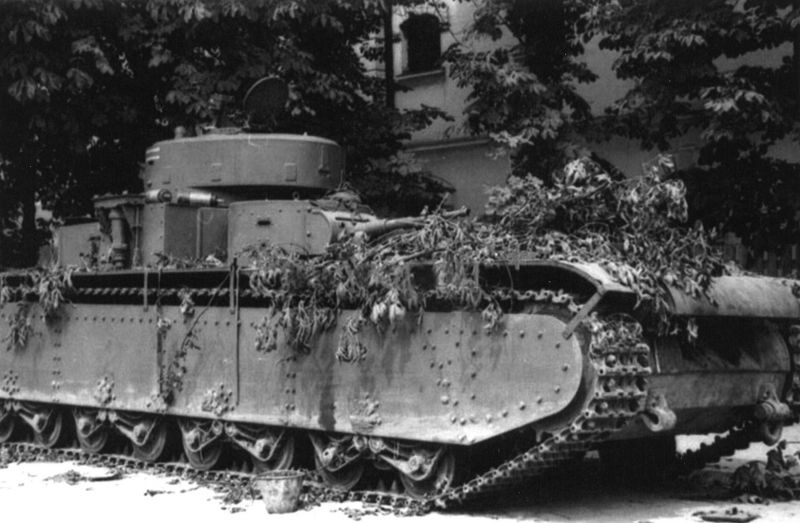
This wartime photograph shows an abandoned Soviet T-35A heavy tank in Dnepropetrovsk during the Battle for Ukraine in 1941. One of the largest armored vehicles fielded by the Red Army before the war, the T-35 became an icon of Soviet military parades during the 1930s but proved poorly suited to the fast-moving campaigns of 1941.
The image captures not a battlefield victory or defeat, but the fate that befell most T-35 tanks during the opening months of Operation Barbarossa.
The Multi-Turret Concept
The T-35 was designed during the early 1930s, when many military planners believed that future breakthrough tanks should engage several targets simultaneously. Instead of mounting all weapons in a single turret, designers distributed them among five separate turrets.
The T-35 carried:
- One 76.2 mm main gun.
- Two 45 mm cannon turrets.
- Multiple machine-gun positions.
- A crew of up to eleven men.
Although impressive on paper, the design resulted in a vehicle that was extremely large, mechanically complicated, and difficult to maintain.
Production and Service
Only 61 production T-35 tanks were built, making the vehicle one of the rarest Soviet heavy tanks produced in series. Most served with the 34th Tank Division of the 8th Mechanized Corps, stationed in western Ukraine before the German invasion.
By June 1941, the T-35 was already considered outdated, yet it remained in frontline service because no suitable replacement was available in sufficient numbers.
Why So Many Were Lost
Contrary to popular belief, relatively few T-35s were destroyed in tank battles.
Historical records indicate that:
- Most were abandoned after mechanical breakdowns.
- Only seven were confirmed destroyed in combat.
- One vehicle was listed as missing.
Long road marches, insufficient recovery equipment, and the rapid pace of the Soviet retreat contributed more to their loss than direct enemy fire.
The Tank in This Photograph
The vehicle shown belonged to the 67th Tank Regiment. By the time this photograph was taken in Dnepropetrovsk, the retreat of Soviet forces had already left many damaged or immobilized vehicles behind.
The image illustrates the practical limitations of one of the most ambitious armored vehicle designs of the interwar period.
The Last Surviving T-35
Although nearly every operational T-35 was lost during 1941, one complete example survives today. Preserved at the Kubinka Tank Museum, it remains the only intact production T-35 and provides historians with a rare opportunity to study one of the most unusual tanks of the Second World War.
Reports also suggest that two T-35s participated in the defense of Moscow, although documentation of their final combat service remains incomplete.
Historical Significance
The T-35 represents the end of an era in armored warfare. Experience gained during the first years of the Second World War demonstrated that multiple turrets added complexity without providing sufficient tactical advantages. Nearly every major tank-producing nation eventually abandoned the concept in favor of a single, more powerful main turret.
Today, the T-35 is remembered not only for its imposing appearance but also as an important step in the evolution of tank design.
Photo Information
- Subject: Abandoned T-35A heavy tank.
- Unit: 67th Tank Regiment, 34th Tank Division.
- Location: Dnepropetrovsk, Ukrainian SSR.
- Date: 1941.
Recommended Literature
- Mikhail Svirin — Stalnoy Kulak Stalina
- Steven J. Zaloga — Soviet Tanks and Combat Vehicles of World War Two
- Mikhail Baryatinskiy — Soviet Heavy Tanks
- Richard Ogorkiewicz — Tanks: 100 Years of Evolution
The abandoned T-35A shown in this photograph symbolizes the transition from ambitious interwar armored concepts to the harsh realities of modern mechanized warfare. Impressive in size and firepower, the tank ultimately demonstrated that reliability, mobility, and maintainability were just as important as armor and weapons on the battlefields of the Second World War.