Junkers Ju 87B dive bomber of III./St.G 3 after a forced belly landing during the Battle of France, summer 1940.
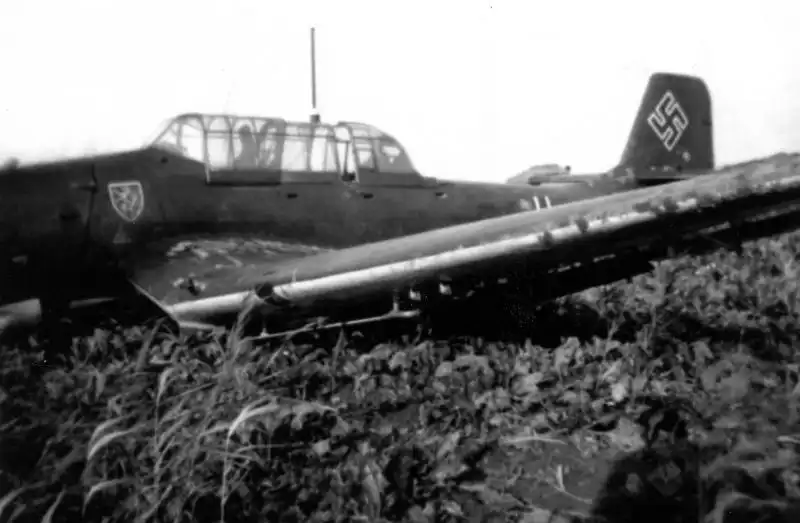
This wartime photograph shows a German Junkers Ju 87B "Stuka" dive bomber after a forced landing during the Battle of France in the summer of 1940. The aircraft belonged to III./Sturzkampfgeschwader 3 (III./St.G 3), one of the Luftwaffe's dive-bomber groups that supported German ground forces during the rapid campaign in Western Europe.
Although the Battle of France is often remembered as a swift German victory, photographs such as this reveal that aircraft losses, mechanical failures, and emergency landings were a routine part of combat operations.
The Junkers Ju 87B "Stuka"
The Ju 87 was Germany's principal dive bomber during the early years of the Second World War. Designed specifically for precision attacks against ground targets, it became one of the most recognizable military aircraft of the conflict.
The Ju 87B variant featured:
- A crew of two.
- Fixed landing gear with streamlined fairings.
- Automatic dive-recovery equipment.
- High bombing accuracy during steep dive attacks.
During the campaigns in Poland, Norway, the Low Countries, and France, the Stuka proved highly effective when operating under Luftwaffe air superiority.
Emergency Landing Procedure
One unusual feature of the Ju 87 was its fixed landing gear. Unlike retractable undercarriages, it created additional drag but simplified construction and improved reliability on rough airfields.
In the event of a forced landing, the landing gear could be jettisoned using explosive bolts. Removing the gear reduced the likelihood of the aircraft digging into soft ground and overturning during a belly landing.
The missing landing gear visible in this photograph is consistent with this emergency procedure.
Why Forced Landings Occurred
Combat aircraft did not always return to base successfully. Forced landings could result from several causes:
- Battle damage.
- Engine or mechanical failure.
- Fuel shortages.
- Navigation problems.
- Damage sustained during anti-aircraft fire.
Even experienced crews operating during successful offensives faced these hazards on a regular basis.
III./St.G 3 During the Battle of France
The aircraft belonged to the third group of Sturzkampfgeschwader 3, a Luftwaffe dive-bomber wing that participated in operations during the Battle of France in 1940. Units equipped with the Ju 87 supported advancing German ground forces by attacking bridges, artillery positions, troop concentrations, and other tactical targets.
The high operational tempo placed continuous demands on both aircrews and maintenance personnel, contributing to losses from operational causes as well as enemy action.
Historical Significance
This photograph illustrates an often-overlooked aspect of wartime aviation. Not every aircraft loss resulted from aerial combat. Mechanical problems, difficult landings, weather conditions, and operational wear also accounted for significant numbers of damaged or abandoned aircraft throughout the war.
Images like this help historians understand the practical realities of sustaining large-scale air operations during one of the Luftwaffe's most successful campaigns.
Photo Information
- Aircraft: Junkers Ju 87B "Stuka"
- Unit: III./Sturzkampfgeschwader 3 (III./St.G 3)
- Location: France
- Date: Summer 1940
Recommended Literature
- Peter C. Smith — Junkers Ju 87 Stuka
- Manfred Griehl — Junkers Ju 87 Stuka
- Chris Goss — Luftwaffe Fighters and Ground Attack Units 1939–1945
- Richard Overy — The Air War 1939–1945
The forced landing of this Junkers Ju 87B offers a glimpse into the everyday risks of military aviation during the Battle of France. Beyond dramatic combat footage and successful bombing missions, wartime flying also involved mechanical failures, emergency procedures, and the constant challenge of bringing both aircraft and crew safely back from each mission.