Soviet BA-10 armored car abandoned after a mechanical breakdown alongside a PARM-1A mobile repair workshop during the Red Army retreat, USSR, August 1941.
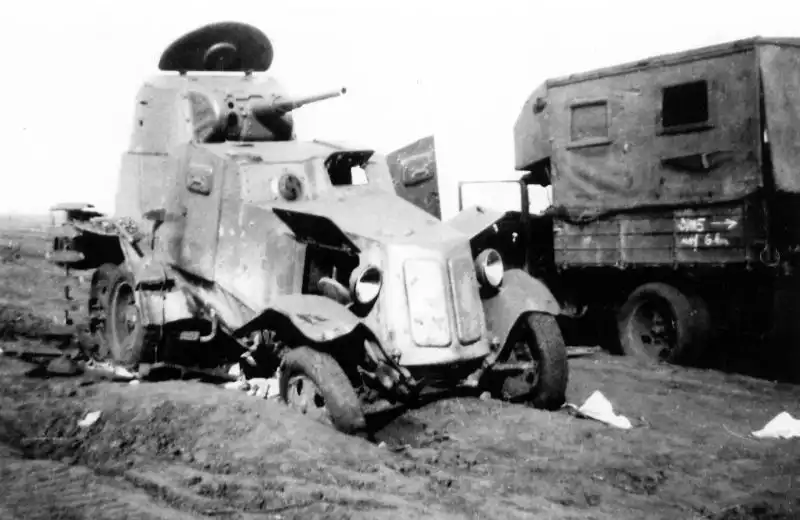
This wartime photograph shows a BA-10 Soviet armored car abandoned during the Red Army's retreat in August 1941. Standing beside it is a PARM-1A mobile repair workshop built on the GAZ-AA truck chassis. Together, the two vehicles illustrate the severe logistical difficulties faced by Soviet forces during the opening months of Operation Barbarossa.
Rather than depicting a battlefield destroyed by artillery or tanks, the image records another common reality of the 1941 campaign: equipment that could no longer be repaired or recovered before advancing German forces reached the area.
The BA-10 Armored Car
The BA-10 was the Red Army's principal medium armored car before the German invasion of the Soviet Union. Built on a modified GAZ-AAA three-axle truck chassis, it combined good road mobility with a rotating turret armed with a 45 mm gun and coaxial machine gun.
The vehicle was primarily intended for:
- Reconnaissance missions.
- Security and patrol duties.
- Infantry fire support.
- Communication between advancing formations.
Although well armed for its class, the BA-10 remained a wheeled vehicle whose mobility depended heavily on road conditions and mechanical reliability.
Evidence of Mechanical Failure
The photograph shows the engine access panels opened, suggesting that the crew attempted repairs before abandoning the vehicle. Its machine guns have also been removed, a common practice intended to prevent usable weapons from falling into enemy hands.
Such details indicate an organized abandonment rather than the immediate aftermath of combat.
The PARM-1A Mobile Workshop
Parked next to the armored car is a PARM-1A mobile repair workshop based on the GAZ-AA or GAZ-MM truck chassis. These vehicles carried tools, spare parts, and equipment required for field maintenance of military vehicles.
The presence of the workshop makes the scene particularly informative. It suggests that repair personnel attempted to restore the armored car to service but were ultimately forced to leave both vehicles behind.
German trophy markings visible on the workshop indicate that the abandoned equipment was later inspected or collected by Wehrmacht recovery units.
The Summer of 1941
During the first months of the German invasion, Soviet forces frequently conducted rapid withdrawals under intense operational pressure. Recovery units often lacked sufficient time, fuel, or heavy towing equipment to evacuate disabled vehicles.
As a result, equipment losses occurred for many reasons:
- Mechanical breakdowns.
- Fuel shortages.
- Lack of spare parts.
- Insufficient recovery vehicles.
- The rapid advance of German forces.
Many armored vehicles were therefore abandoned intact or only lightly damaged, despite never having been knocked out in combat.
Historical Significance
This photograph provides valuable evidence of the logistical challenges faced by the Red Army during the summer of 1941. It illustrates that the effectiveness of an army depends not only on weapons and crews, but also on its ability to maintain, repair, recover, and supply its equipment under combat conditions.
Images such as this help explain why material losses during the opening phase of the German–Soviet war were so severe, even in cases where vehicles had not been destroyed by enemy fire.
Photo Information
- Subject: BA-10 armored car and PARM-1A mobile repair workshop.
- Location: Western USSR.
- Date: August 1941.
- Operator: Red Army.
Recommended Literature
- Mikhail Baryatinskiy — Armored Cars of the USSR 1917–1945
- Steven J. Zaloga — Soviet Tanks and Combat Vehicles of World War Two
- David M. Glantz — Barbarossa Derailed
- John Erickson — The Road to Stalingrad
The abandoned BA-10 and the nearby PARM-1A workshop capture one of the defining realities of the Eastern Front in 1941. Mechanical failures, logistical limitations, and the speed of military operations often determined the fate of military equipment just as much as enemy fire. The photograph stands as a reminder that successful warfare depended not only on fighting, but also on the ability to keep machines moving.